
Few pastors leave the pulpit each year, but those who do mostly say it was a personal decision.
According to a Lifeway Research study of former senior pastors in four Protestant denominations who stepped down before retirement age, 4 in 5 (81%) felt sure during most of their ministry at their last church that they could stay there as long as they wanted.
For more stories at your doorstep, subscribe to The Baptist Paper.
SIGN UP for our weekly Highlights emails that hit your inbox on Monday, Wednesday and Friday.
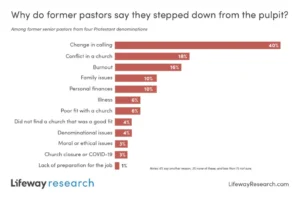
Only around 1% of U.S. Protestant pastors leave the ministry each year, according to the most recent Lifeway Research study. Among pastors from four denominations who step down, 2 in 5 (40%) say it was related to a change in their calling.
Other leading causes
Other leading causes are conflict in a church (18%), burnout (16%), family issues (10%) and personal finances (10%). Some point to an illness (6%), being a poor fit with a church (6%), not being able to find a church that was a good fit (4%), denominational issues (4%), or the church closing or issues related to the pandemic (3%). Only 1% blame a lack of preparation for the job. While pastors stepping down for a moral or ethical issue garners the most headlines, only 3% are connected to that. Some say another reason (6%) and none of these (3%).
“Because social media tends to spread current stories that are far from normative, we run the risk of becoming convinced of falsehoods about pastors today,” said Scott McConnell, executive director of Lifeway Research. “This research study provides uncommon access to a reliable sample from four denominations of those who left the pastorate early, and the most frequent reason for stepping away from the senior pastor role is God’s leadership to do so.”
Who are former pastors?
While some pastors left the pulpit only a few years short of retirement, others had only just begun life in the ministry when they quit. A third (33%) left when they were between 55 and 66, but similar percentages left when they were 45–54 (35%) and 44 or younger (32%).
More than 2 in 5 (43%) never made it to a second church, leaving pastoral ministry entirely after their first. The same percentage (43%) served as a senior pastor for 10 years or less, including 21% who served five years or less. Around a third (32%) were a senior pastor between 11 and 20 years, while a quarter (25%) stood behind the pulpit for more than 20 years.
For 3 in 4 former pastors, their last stop, whether it was their first or not, didn’t last long. Almost three-quarters (73%) served as a pastor at their last church for 10 years or less, including 45% who were there for five years or less. One in 5 (20%) were at their last church between 11 and 20 years before leaving the ministry. Just 7% say their last tenure lasted 20 or more years.
Despite stepping away from the pulpit, half (53%) of former pastors are still working in the ministry, just in a role other than pastor. A third (32%) work in a non-ministry role. Few took early retirement (7%), disability (3%), are currently looking for work (2%) or have some other employment situation (2%).
“It’s not surprising to see the majority of former pastors still working in ministry,” said McConnell. “In addition to many feeling called to their new role, the majority of current Protestant pastors say they have limited non-ministry work experience, with 6 in 10 having worked outside of ministry for 10 years or less before becoming a pastor.”
Church conflict
Conflict, the second-leading reason pastors become former pastors, is a reality in many congregations, but for some leaders, it becomes too much.
Almost half (45%) of former pastors say they experienced significant conflict in their church during the last year they served as pastor. Additionally, 9 in 10 (87%) faced conflict at some point in their last congregation, most commonly over changes they had proposed (56%). Half of former pastors had conflict with lay leaders (50%) or experienced a significant personal attack (49%).
Around 2 in 5 saw conflict over expectations about the pastor’s role (40%) or their leadership style (38%). Close to a quarter experienced conflict related to national or local politics (27%) or doctrinal differences (22%). One in 8 (12%) say none of these.
“The experiences of those who left the pastorate early include more conflict than the typical current pastor has,” said McConnell. “Among evangelical and Black Protestant current pastors, only 19% experienced significant conflict this last year, while 45% of former pastors from these four denominations had significant conflict their last year as pastor.”
It’s not as though former pastors were blindsided by the existence of conflict. Nine in 10 (92%) say they expected there would be a need to confront conflict in their church. Almost as many (86%) say they consistently listened to people in their church for signs of conflict. Similarly, 84% invested in processes and behaviors to prevent conflict. Additionally, most (55%) say their training prepared them to handle the people side of ministry.
For more information, view the complete report and visit LifewayResearch.com.
EDITOR’S NOTE — This story was written by Aaron Earls and originally published by Lifeway.