Brent Leatherwood’s resignation as president of the Southern Baptist Convention’s Ethics & Religious Liberty Commission in July leaves the trustees with the unenviable task of finding a replacement — and the looming question: Can anyone speak for Southern Baptists without making them mad?
Leatherwood resigned July 31, six weeks after 43% of messengers to the SBC Annual Meeting in Dallas voted to abolish the entity that represents the Convention among political leaders. This was the second consecutive vote to defund the public voice that failed to reach a required majority vote.
For more stories at your doorstep, subscribe to The Baptist Paper.
SIGN UP for our weekly Highlights emails.
Leatherwood was left in an untenable position — he needed to rebuild trust with nearly half the churches and pastors in the convention, while he himself had become the most visible symbol of widespread dissatisfaction with the entity. So he resigned.
Now the search begins for a new leader.
“We’re not going to let grass grow under our feet,” ERLC Trustee Chair Scott Foshie said. “We need that leader soon.”
‘We need a bridge builder and unifier’
The trustees elected a seven-member search team from among their number on Aug. 14. The process of bringing a nominee to the full board for consideration will take months. Having a new president in place to lay out a new course prior to the 2026 convention in Orlando would be desirable in the effort to rebuild trust with the SBC grassroots. In the meantime, an interim president may be named by the trustees.
“We need a bridge builder and unifier,” Foshie said of the next permanent leader. “We need someone with a pastoral posture, who is going to help Southern Baptists realize that we agree on more issues than we might think we do.”
Foshie is an IBSA employee who began serving as an ERLC trustee while he was pastor of Steeleville Baptist Church. Foshie said he has heard from rank-and-file Baptists who said they voted to abolish the ERLC only because “they didn’t know any other way to get our attention. We’ve been listening, and they continue to have our attention.”
Tightrope
Learning how to speak for people with strong views on some issues, such as religious freedom and pro-life while holding a broader range of opinions on others will mean walking a tightrope.
Leatherwood tried to refocus on pro-life issues, and ERLC recently had success lobbying Congress to defund Planned Parenthood. But Leatherwood ran afoul of Baptist opinion makers when he supported Tennessee gun legislation after his children’s school was attacked by 28-year-old former student with an automatic weapon, killing three children and three adults, and when he saluted President Biden for “doing the right thing” by withdrawing from the 2024 Presidential race.
The next ERLC president must stick to issues closer to the Baptist heartbeat. “Early on in his tenure, he will have to spend a lot of time in churches and with pastors,” Foshie said, “and learn which issues we have a supermajority consensus about, and which we don’t.”
Searching for a Statesman
Foshie uses the term “statesman” to describe the kind of representative he hopes to see in the role. Leatherwood had experience in the Tennessee Republican Party and served as chief of staff under former ERLC President Russell Moore. He built teams.
Moore fashioned his role as a theologian and later assumed a “resident theologian” position with publisher Christianity Today when he resigned the ERLC under duress in 2021.
Moore’s predecessor, Richard Land, took on a more statesman-like stance during his 25 years in the post, ending in 2014. Land said the search committee’s choice is “critical.” He told The Baptist Paper that the ERLC has the greatest opportunity “it has ever had” to represent the SBC in Washington D.C. Many leaders there are “very sympathetic” to Southern Baptist causes.
“That’s why I thought it would be so tragic if we would have voted to defund the ERLC precisely at the moment where it’s got the opportunity to have more impact than it’s ever had,” he said.
The challenge now is that the SBC entity is “still suffering from policy decisions of former ERLC administrations,” Land said. “I thought Brent did an excellent job under difficult circumstances.”
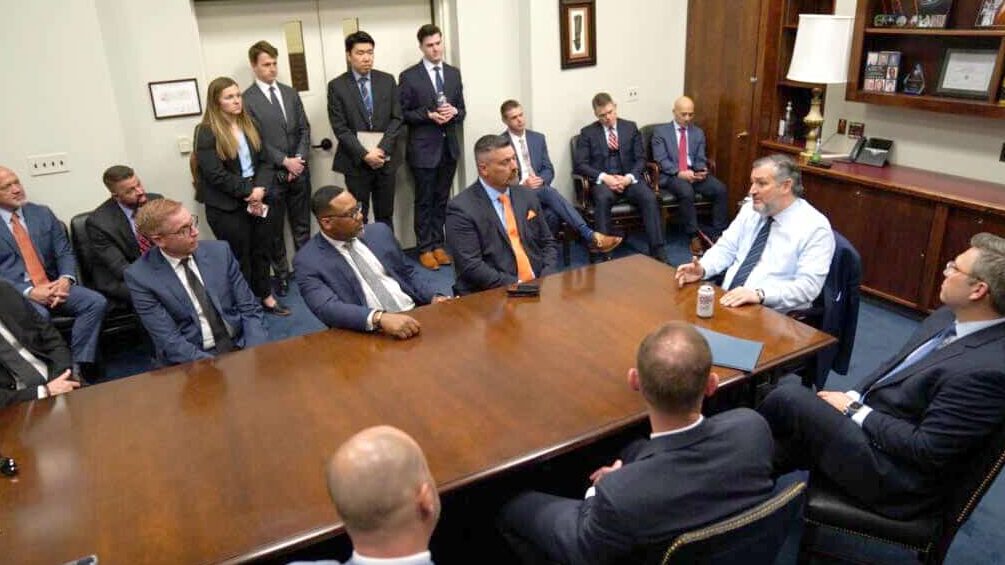
Foshie points to the ERLC-organized visits to the Capitol by groups of pastors as evidence of open doors for Baptists — and as evidence of recent redirection under Leatherwood.
“Politicians appreciate hearing from pastors,” Foshie said, “because they represent constituents. ERLC has a team representing Southern Baptists on Capitol Hill and at the Supreme Court who are well respected. They will continue to work there, but we need pastors to be engaged too. That gets more attention from politicians.”
Rebuilding trust
The main issue in the meantime is rebuilding trust within the denomination. More than 4-in-10 messengers voted twice to pull the plug on the ERLC. The social media discussion continues among leaders who advocated against it. But Foshie is optimistic for a new chapter. “Southern Baptists are a forgiving people,” he said. “They want to give ERLC another opportunity to give representation they can trust, but they expect results.”
Foshie said the trustees are listening, as will the search committee. The best conduit for church members’ input is to talk with their state’s ERLC trustees.
“As we’re waiting for these resumes to come in, we’re going to be doing a lot of listening. Then we will be continuing to listen to God and relying on feedback we receive to show us what God wants in the next season for the ERLC.”
EDITOR’S NOTE — This story was written by Eric Reed and originally published by the Illinois Baptist.