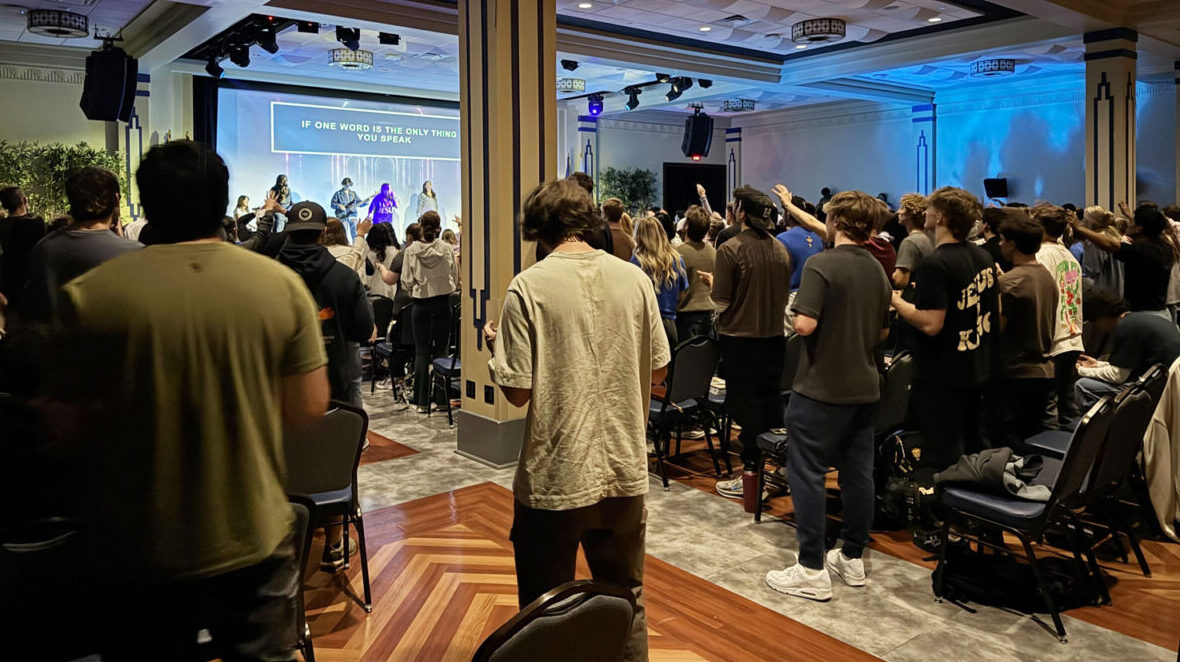
It’s 9 p.m. on Oct. 13, a Monday, on the University of Pittsburgh’s campus. There are two NFL games on TV and fall midterms are this week — but roughly 300 students are packed into a room in the student union building, clapping or raising their hands in worship.
“No treasure of this life could ever satisfy,” the students sing, some standing, others kneeling in the back. “God, you are my everything.”
Moments later, the group’s founder, 34-year-old Jordan Kolarik, grabs a mic and heads to the front of the room to deliver a message on devotion. He’s nearly buzzing with energy as he reads aloud a passage from Matthew 26 about a woman anointing Jesus with expensive perfume.
For more stories at your doorstep, subscribe to The Baptist Paper.
SIGN UP for our weekly Highlights emails.
“You can believe the right things, you can say the right things, you can kind of go to church, but never have real devotion to Jesus,” he says.
In fall 2022, Kolarik, a Pittsburgh native and former high school teacher, launched this chapter of Chi Alpha with just eight volunteers. This year, the student chapter, which is affiliated with the charismatic, evangelical denomination Assemblies of God, has 77 student small group leaders leading hundreds of students.
“It’s sort of like a pyramid scheme for Jesus,” Kolarik joked.
Though the chapter’s growth is striking, students say it’s part of a broader stirring on campus. The Pittsburgh Oratory, a Catholic campus ministry serving several Pittsburgh universities, recently began hosting Sunday Mass in a larger chapel due to surging student attendance. In September, the University of Pittsburgh football team made national headlines for spearheading what some called a campuswide “revival”; roughly 65 students reportedly professed faith in Christ and 80 were baptized.
And the displays of devotion aren’t exclusive to Pittsburgh. The Ohio State football team has drawn national attention for baptizing dozens of students at public “Invitation to Jesus” events. The campus movement UniteUS, which brings large-scale evangelical worship and baptism events to colleges, reports that 13,000 college students have made “decisions to receive Christ” since 2023.
Now, in the wake of the assassination of Christian activist Charlie Kirk, claims of nationwide revival are escalating.
“Charlie started a political movement but unleashed a spiritual revival,” Defense Secretary Pete Hegseth declared at Kirk’s memorial service. Political commentators, TPUSA spokespeople and Christian worship leaders have also linked Kirk’s passing with revival, especially among young people.
Overblown?
But while some news outlets has claimed that members of Generation Z are returning to church in astounding numbers, religious trends researcher Ryan Burge said assertions of revival are largely overblown: “We’re not seeing anything at the scale that would even begin to point me in the direction of a sustained, significant, substantive revival in America right now,” he told RNS. “It’s not a return to religion among Gen Z. It’s just they’re not leaving as fast as millennials did when they were in their late teens and early 20s.”
Recent data from the evangelical Christian polling firm Barna Group has been widely cited to support revival claims. While most data about religion and young people shows that Gen Zers are the least likely to attend services, Barna’s model found that among those already attending church, Gen Zers attend more regularly than other generations of churchgoers — 1.9 times per month, just slightly more frequently than millennial churchgoers (1.8 times). Barna CEO David Kinnaman also told RNS there’s “a higher percentage of Gen Zers today than five years ago who are saying they have made a commitment to Christ.”
Still, while Kinnaman said he’s personally praying for revival, as a researcher he’s using the language of “renewal” to describe what he’s seeing so far. And Barna has also reported counter trends, with Gen Z women being increasingly likely to identify as religiously unaffiliated.
Conflicting claims of revival could be due in part to different definitions of the term. Some use “revival” to describe a high-octane religious event; the Rev. Adam Miller, a pastor of Pittsburgh’s Life Church and mentor to several Pitt football players, said revival is, “at a base level,” a movement “from death to life” that also “goes beyond a moment.”
Burge said that from a research standpoint, it would require overwhelming evidence from multiple sources to demonstrate revival.
“If we talk about the First Great Awakening and the Second Great Awakening … the entire trajectory of religion in America changed in those moments,” Burge said. “My definition of revival is a whole lot more people going to a house of worship this weekend than a year ago. And by a whole lot, I don’t mean 100,000 nationwide or 500,000 nationwide. I mean 5 million, 10 million, 15 million. That’s what a revival is like.”
EDITOR’S NOTE — This story was written by Kathryn Post and originally published by Religion News Service.