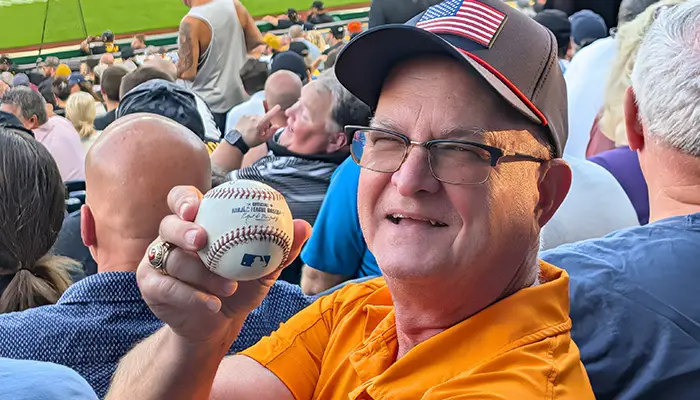
Exploring the unusual circumstances surrounding his birth, retired Southern Baptist pastor Steve Simpson discovered an unexpected connection to the Holocaust.
“I remember my mother quite often saying the last words she heard (her doctor) say were, ‘Mrs. Simpson, you have a boy,’” Simpson recalled. “Then she said there was some commotion and they knocked her out. She thought there was something wrong with me, and when she came to, discovered the doctor had died.”
For more stories at your doorstep, subscribe to The Baptist Paper.
SIGN UP for our weekly Highlights emails.
Despite the unusual circumstance at his birth, Simpson, in his own words, “grew up a good little Baptist boy in Virginia.” Then he went to Fort Worth, Texas, for seminary and came back to pastor in Virginia, then North Carolina. He pastored Riverbend Fellowship in New Bern for 33 years. He’s now four years into retirement and helping plant churches.
In 1957, Simpson’s dad was stationed at the naval base in Groton, Connecticut. The base hospital was not equipped for labor and delivery, so military wives used local doctors and hospitals.
Simpson said his mother told stories about a friend who was expecting at the same time as her. The two women scheduled doctor’s appointments together and grew close to their doctor, who was Jewish.
When he would see the women enjoying ice cream after their appointments, he would tease them. It was obvious he cared about his patients.
“My birth was complicated,” Simpson said. “By not taking care of himself, I feel like (the doctor) chose my life over his. My mom knew he was Jewish, gave me his name, and for years I felt like I had two Jewish saviors.”
Simpson didn’t know much about the man who helped bring him into the world, only the few stories his mom would tell and the fact that he had a brother who was also a doctor. Simpson also knew the brother’s name.
“That’s as much as I knew.,” Simpson said. “But in my church in New Bern, friends started researching, and lo and behold, they pulled up photographs of his gravestone. I was drawn to go and possibly contact some of his descendants.”
Searching
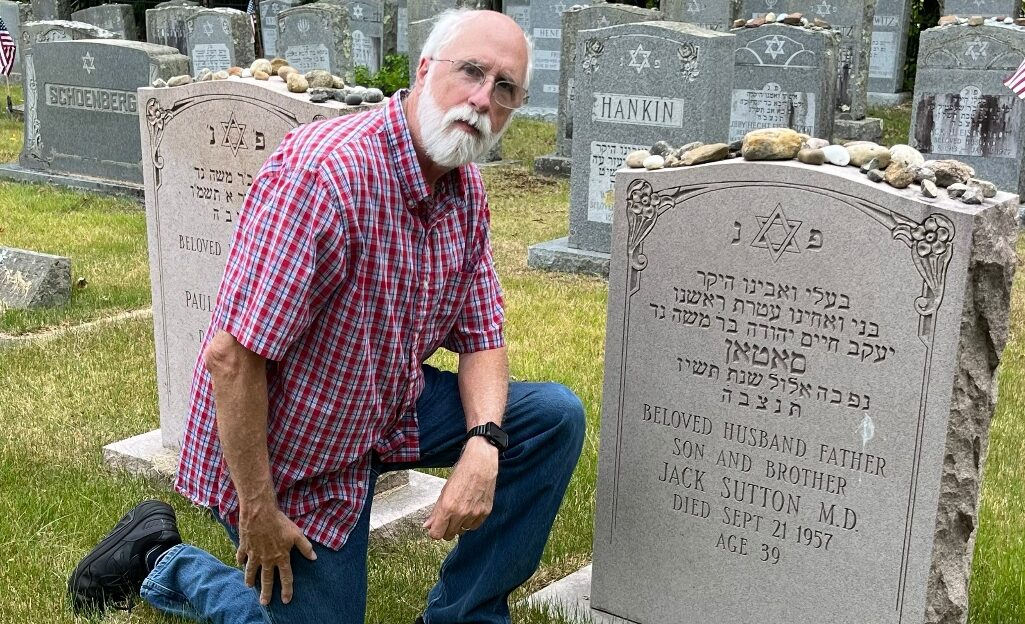
Last summer, Simpson and his wife Ruth made the journey to Connecticut. After locating the large cemetery, they began searching. After a while, Simpson became frustrated, thinking they had made the journey but might not be able to find the grave.
“I was walking around with my phone, and my wife just started going row by row by row. I was on one side of the cemetery, and she was on the other when she yelled, ‘I found it.’
“I cannot describe the feeling; it was just overwhelming for me. I knew what he’d done. I just had a feeling of great gratitude.”
Turns out, the doctor was born Jakob Chaim Szmuszkowicz in Lodz, Poland, in 1917, the youngest of three sons of a family that owned a clothing manufacturing business. The city of Lodz was the center of the clothing industry in Poland. In 1939, fearing an invasion from Germany, Jakob and his parents fled to Palestine. His older brother Pawel, who was already a physician, was able to flee to the United States. He settled in Connecticut, anglicizing his name to Paul Sutton. The eldest brother Lova, later Leon Sutton, remained in Lodz to manage the family business.
The Germans invaded Poland in the fall of 1939, and the Jewish ghetto in Lodz was cordoned off in 1940. It was the second largest Jewish ghetto in Europe behind Warsaw. Because the workshops in Lodz manufactured uniforms for the German army, the Jewish leadership of Lodz helped to forestall, for a time, deportation to the concentration camps. In 1944, the remaining brother Lova was sent to Auschwitz.
Meanwhile, Jakob made his way from Palestine to the United States in 1942. He anglicized his name to Jack Sutton and took up residence in Connecticut with his brother Paul. In 1943, he was inducted into the U.S. Army, serving in Europe until 1946. He entered medical schools in Austria and Switzerland. In 1946, he married Ann Leichtag, born in Hungary, who was also listed among the Jewish refugees.
Returning to Connecticut, Jack established a medical practice. His brother Lova survived and was liberated from Auschwitz at the end of the war, immigrating to the United States in 1947. Their parents joined them in 1951. At his death, Jack left a wife and two preschool children.
‘Greater appreciation’
Simpson said discovering this information “gave me a greater appreciation for the Jews, with talk today about the rise of anti-Semitism. I realize that it is (a) common theme that doesn’t go away, it ebbs and flows. I realize that the Jewish people have always been through a struggle.”
In the Jewish tradition of “tz’ror” (Hebrew: pebble/bond) Simpson left a stone on top of Sutton’s tombstone as a mark of honor and remembrance for his sacrifice.
“To have lived through what he lived through, only to, at 39 years of age, die in the hospital at my birth, is a profound weight that I don’t carry lightly,” Simpson said.
EDITOR’S NOTE — This story was written by Charles Jones and published by the Biblical Recorder.