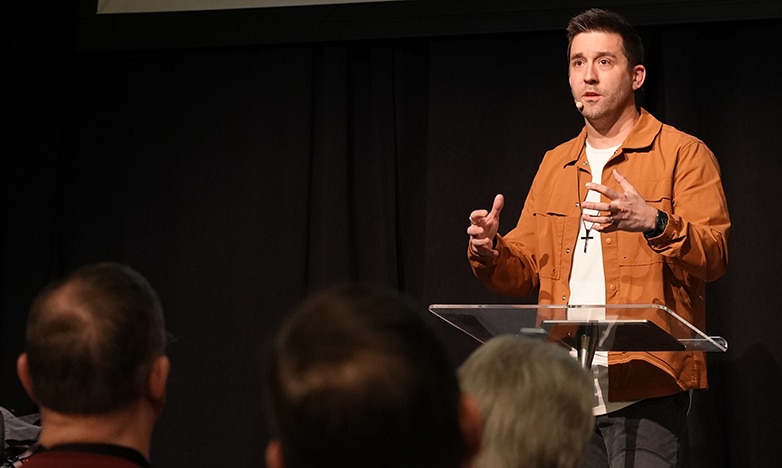
Redefine your measurements for success if you want to reach the next generation, said Seth Conerly, pastor of Metro Community Church. Conerly, who has served in church planting, megachurch ministry, and revitalization settings across the South and Midwest, told Illinois Leadership Summit attenders that many pastors feel pressure to measure effectiveness by attendance growth, expansion and visible results. That mindset, he said, often leads to burnout, discouragement and misplaced motivation.
“God does not measure success by tangible results, but by faithful follow-through,” he said. “Growth is a gift, but faithfulness is the call.”
For more stories at your doorstep, subscribe to The Baptist Paper.
SIGN UP for our weekly Highlights emails.
Reading from Isaiah 6, Conerly highlighted the story of the prophet Isaiah, who willingly accepted God’s call without being promised visible success. Isaiah, he noted, was sent to proclaim the truth to people who would largely reject it.
“We often stop the story at ‘Here am I, send me,’” Conerly said. “But we don’t talk about what Isaiah was actually sent to do, or how little fruit he saw in his lifetime.”
Laboring in difficult places
He warned against equating obedience with outcomes, saying pastors and churches are not failures simply because their efforts do not result in rapid growth or cultural influence. Faithfulness, Conerly said, may involve laboring in difficult places, serving resistant congregations or investing in future generations without seeing immediate results.
He also challenged leaders to examine whether they are truly called to their current ministry context. Discernment of calling, he said, should come before strategy, programming, or generational outreach plans.
“If you are not called to where you are serving, you will do no good there long-term,” Conerly said. “But if you are called, then stay and be faithful, regardless of the metrics.”
Conerly said young adults today are hungry for authenticity rather than performance-driven or attraction-based models of church. They want genuine encounters with God, not manufactured experiences.
“We’re in a unique season where people are tired of fake and fabricated,” he said. “They’re looking for an authentic interaction with a living God.”
Deeper commitment
Conerly emphasized that churches do not need to rely on trendy strategies or specific ministry “vehicles” to reach the next generation. Instead, he encouraged leaders to focus on cultivating “biblically grounded environments” that are relationally honest and spiritually formative.
While practical systems and organization still matter, Conerly said they must flow from a deeper commitment to spiritual faithfulness rather than institutional success.
“Christ doesn’t define ministry success by numbers,” he said, “but as being faithful people, pursuing Him in our hearts, in our minds, in our souls.”
“Our responsibility,” he said, “is to be faithful to who God has called us to be and trust Him with the results — even if we never see them.”
More than 200 church leaders attended the Illinois Leadership Summit held Jan. 20–21 at the IBSA Building in Springfield.
EDITOR’S NOTE — This story was written by Lisa Misner and originally published by the Illinois Baptist.