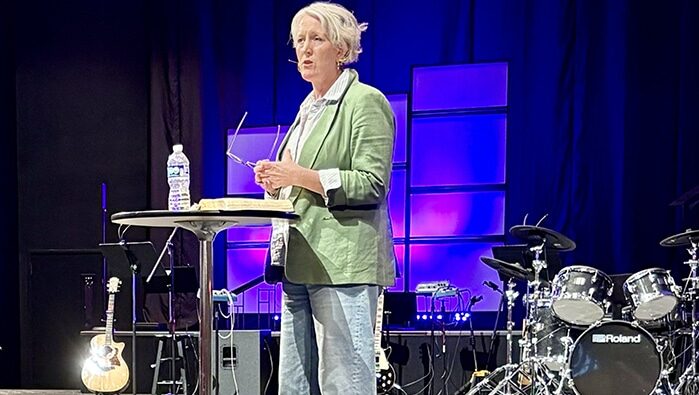
“If I reach down to my thigh, I can feel what feels like a bullet wound,” veteran missionary, Tina Boesch told women recently attending Priority 2026 event. “And that would be a great story, wouldn’t it, if I actually had a bullet wound? I don’t.”
The injury, caused by a metal radiator pipe that punctured her leg as she rushed for a bus, resulted in weeks of daily medical visits in a post-Soviet hospital system that lacked pain medication. Yet Boesch said the experience became a formative moment in her understanding of ministry – her realization that pain and vulnerability are not obstacles to Christian ministry, but often the very means through which it advances.
Boesch, who served 19 years with the International Mission Board in Central Asia, recounted the experience from her first solo missions experience overseas at age 19, when a serious leg injury in Slovakia, left her alone and dependent on strangers for help.
“That wound ended up being an open door for ministry,” she said. “It wasn’t ministry that I could have orchestrated. It was only something that the Lord could do in his own time and his own way.”
‘Beautiful scars’
Now the manager of the Bible Study Team at Lifeway, where she has worked for six years, Boesch framed her personal story as a lens for understanding the Apostle Paul’s second letter to the Corinthians, the focus the conference theme, “Beautiful Scars: From Pain to Purpose.”
“This is the most vulnerable of all Paul’s letters,” she said, describing a relationship she called “strained” between Paul and the Corinthian church he founded. Paul faced criticism, slander and misunderstanding from the very believers he loved, Boesch noted.
“They’re saying things like, ‘His letters are weighty and powerful, but his physical presence is weak and his public speaking amounts to nothing,’” she said during the April 24 event. “We’re talking about the Apostle Paul, and this is a church he planted.”
Despite personal suffering — including what Paul refers to as his “thorn in the flesh” — Boesch said Paul chose to respond with love rather than withdrawal or defensiveness.
“He leans into vulnerability and love,” she said. “Pain never disqualifies you from ministry.”
Central to her message was Paul’s teaching in 2 Corinthians chapter 4, where he outlines the purpose and character of Christian ministry. She emphasized what Paul later described in chapter 5 as “the ministry of reconciliation.”
“It’s taking two things that are far apart, opposed to each other, and bringing them together,” Boesch said. “In Christ we are reconciled to God, and we are reconciled to one another.”
‘Ministry is hard. … But we do not give up’
That ministry, she said, requires perseverance, even in the face of spiritual opposition.
“Ministry is hard. Life is hard,” she said. “But we do not give up.”
Using imagery from Exodus and Numbers, Boesch described Paul’s references to veils, light and glory as part of a larger biblical story in which God’s presence, once mediated through Moses, is now revealed fully in Jesus Christ.
“The veil has been lifted,” she said. “You have seen the shine, and now your purpose is to radiate that shine to others.”
Reflecting on her own scars — including one from an emergency cesarean section — Boesch said they serve as reminders of God’s faithfulness.
“Wounds are not beautiful, but scars are beautiful because they are evidence and a witness to healing,” she said.
As she concluded, Boesch encouraged attendees to see their own experiences of pain as part of a larger calling.
“That is the purpose we were made for,” she said. “To be a blessing to all the nations.”
Host churches for the three conference sites were Tabernacle Baptist Church in Decatur (Central Illinois), the main conference site, Grace Missionary Baptist Church in Markham (Chicago area) and Bethel Baptist Church in Troy (Metro East). The April 24–25 conference was also simulcasted to 13 local churches.
EDITOR’S NOTE — This story was written by Lisa Misner and originally published by the Illinois Baptist.