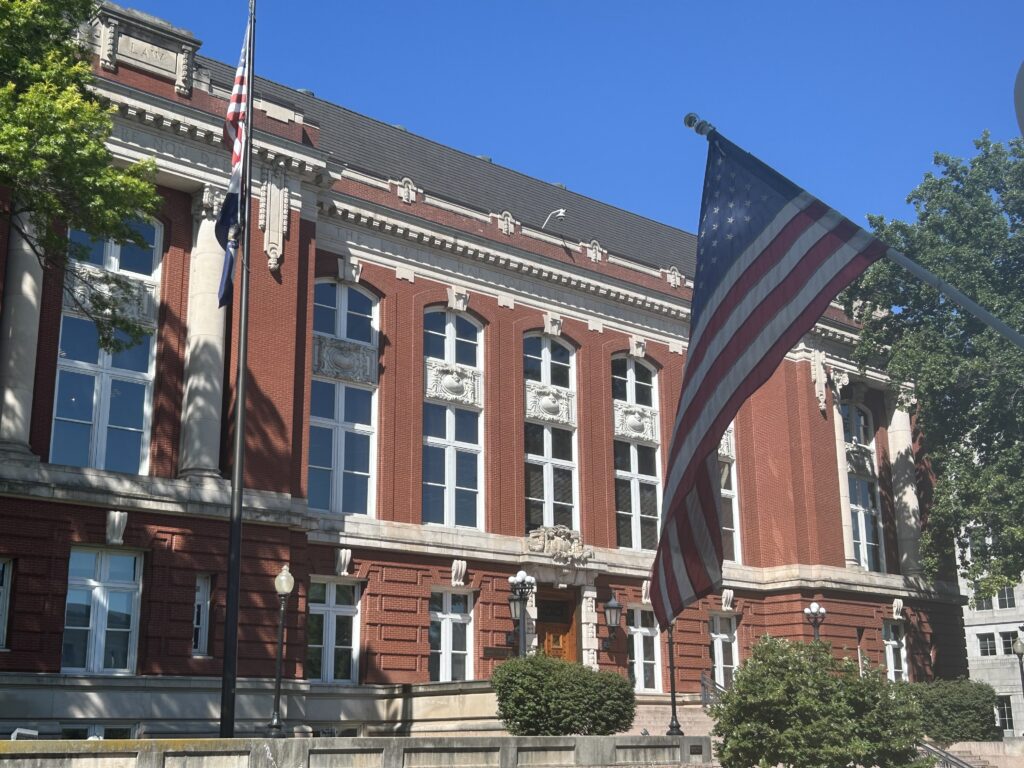
A question from Missouri Supreme Court Judge Mary R. Russell during oral arguments Sept. 23 may have captured what many Missouri Baptist parents are wondering about books containing graphic sexual images in public school libraries.
“Are those actually on the shelves at our public school libraries?” Russell asked an attorney representing school librarians who are challenging a Missouri law prohibiting school personnel from providing sexually explicit material to students.
The question arose after the Missouri Attorney General’s office submitted examples of sexually graphic illustrations taken from three books that had been available in Missouri high school libraries.
Attorney David Thoreson acknowledged that the books had been in some high school libraries before the new law was passed, and some schools had removed those books after the new law was passed. He argued, however, that in his opinion, they did not violate the new or old statutes and therefore need not have been removed.
The exchange illustrated a fundamental disagreement before Missouri’s highest court: How much authority does the state have to protect school children from sexually explicit material without violating constitutional protections for freedom of speech?
A law intended to protect minor students
In 2022, the Missouri General Assembly enacted Senate Bill 775, including a new criminal statute, Section 573.550, prohibiting school personnel from knowingly providing students with specified forms of explicit sexual material.
The statute applies to administrators, teachers, librarians, school board members and others acting in an official capacity at public or private elementary and secondary schools.
It specifically addresses visual depictions of sexual acts or subjects.
The law contains exceptions for works of art having serious artistic significance, works of anthropological significance and materials used in science and sex education courses.
A violation constitutes a Class A misdemeanor.
Supporters viewed the legislation as a measure to protect children from sexual images that should not be made available through school-sponsored collections.
Opponents, including the Missouri Association of School Librarians and the Missouri Library Association, argued that the statute is unconstitutionally vague and threatens librarians with criminal prosecution for providing books containing constitutionally protected expression.
In November 2025, a Jackson County circuit judge agreed with the challengers and struck down the law. Attorney General Catherine Hanaway’s office appealed to the Missouri Supreme Court.
Didn’t Missouri already prohibit pornography for minors?
One of the most revealing exchanges during the Sept. 23 arguments concerned a question that might surprise parents: Missouri already had a criminal statute prohibiting the distribution of pornography to minors long before the 2022 legislation.
Section 573.040 prohibits furnishing material that is legally defined as “pornographic for minors.”
That definition incorporates constitutional standards developed by the United States Supreme Court, particularly in Miller v. California (1973), with modifications recognizing that government has a greater interest in protecting children from pornography than it does as to adults.
3 requirements
Under Missouri’s preexisting law, material is pornographic for minors when it satisfies three requirements:
1. Viewed as a whole, it appeals to the prurient sexual interests of minors under contemporary community standards.
2. It depicts or describes sexual conduct in a patently offensive manner under adult community standards concerning what is suitable for minors.
3. Taken as a whole, it lacks serious literary, artistic, political or scientific value for minors.
The 2022 school-library statute uses a different approach. Rather than incorporating all three elements, it identifies particular kinds of sexually explicit visual material and provides specified exceptions.
That difference is significant.
A book containing graphic illustrations of sexual activity might be covered by the new statute even if the book as a whole possessed literary merit and therefore failed to satisfy the earlier legal definition of pornography for minors.
Indeed, that possibility forms a central part of the constitutional challenge.
During oral argument, Judge Russell observed that the new law appears to omit the first element of the traditional obscenity test, which concerns an appeal to prurient interests.
Chief Justice W. Brent Powell pressed the state’s attorney about why lawmakers had not simply incorporated the definition already found in Missouri law.
Deputy Solicitor General Graham Miller argued that the state may enact overlapping criminal prohibitions, including one specifically addressing the school environment.
When Powell asked whether the two statutes prohibit the same material, Miller answered, “Correct.”
That answer may become important to the court’s ultimate decision.
The attorney general’s position appears to be that the 2022 law reinforces the existing prohibition against pornography for minors rather than substantially expanding the category of material subject to criminal punishment.
But the language enacted by the legislature is not identical to the earlier statute. Whether the court can interpret the newer law narrowly enough to preserve its constitutionality remains a central issue.
Are school libraries different?
Another major issue is whether public school libraries occupy a different constitutional position from bookstores, public libraries and other places where adults exercise their freedom to read.
The state argued that librarians selecting books for public school collections are performing governmental duties rather than exercising an unrestricted personal right to communicate their own views to children.
Under that theory, school authorities have substantial discretion over what materials are appropriate for students.
The attorney general’s office also cited an April 2026 decision of the Eighth U.S. Circuit Court of Appeals involving an Iowa law restricting sexually explicit material in school libraries.
That decision recognized the authority of public schools to make educational judgments about sexual content.
The Missouri statute, however, presents an additional complication because it applies to private schools as well as public schools and imposes criminal penalties rather than merely administrative or employment consequences.
Judge Ginger Gooch questioned whether the state’s school-sponsored speech argument could justify a statute that also regulates private schools.
Solicitor Miller suggested that the provision concerning private schools could be severed if necessary to preserve the law’s application to public schools.
That possibility raises another important issue for Missouri Baptists, many of whose children attend Christian schools.
Private religious schools ordinarily exercise their own independent educational and religious judgments about library collections and classroom materials. A law governing public school speech cannot automatically be defended on the same constitutional theory when applied to private religious institutions.
Why Baptist parents should care
For Baptist parents, the controversy involves more than whether a particular book meets a technical definition of legal obscenity.
Parents entrust schools with substantial responsibility for their children’s education. They reasonably expect school officials to exercise sound judgment about materials made available to children at different ages and developmental stages.
The availability of a book in a school library can also carry an implicit message that school authorities consider it appropriate for students.
That does not mean every book addressing sexuality is pornographic, or that every objectionable passage makes an entire literary work legally obscene.
But neither should parents be expected to accept graphic depictions of sexual activity as appropriate for children simply because such depictions appear within a longer story.
Missouri Baptists have long affirmed the importance of parental responsibility for the moral and spiritual formation of children. Scripture teaches parents to instruct their children diligently and to exercise discernment concerning influences upon their hearts and minds.
Those responsibilities do not disappear when a child enters a public school.
Nor does the First Amendment require schools to place every constitutionally protected publication on their library shelves. Material may enjoy constitutional protection against governmental censorship in society generally without necessarily being appropriate for a school library.
The constitutional question is how lawmakers may translate those educational judgments into enforceable standards, especially when violation of those standards carries criminal punishment.
Parents also have a direct interest in school board policies, opportunities to review library materials and procedures for challenging age-inappropriate content. Those safeguards remain important regardless of the outcome of this litigation.
What is really at stake?
The Missouri Supreme Court faces several possible approaches.
It could agree with the Attorney General that the 2022 law should be interpreted narrowly, as largely reinforcing the existing prohibition against pornography for minors in the school setting.
It could conclude that the legislature constitutionally established a more restrictive standard for sexually explicit visual material made available through schools.
Or it could agree with the librarians that the statute reaches too much constitutionally protected material or fails to give sufficiently clear notice of what conduct is prohibited.
Those outcomes would have substantially different consequences.
If the new law merely duplicates the older prohibition, its principal practical significance may be its specific focus on school personnel and school library materials.
If it establishes a constitutionally permissible broader restriction, schools would have a stronger statutory obligation to exclude certain sexually graphic images that might not meet the traditional legal definition of pornography for minors.
If the law is invalidated, Missouri’s older criminal prohibition against furnishing pornography to minors would remain in place, although the additional school-specific prohibition would not survive.
Whatever the outcome, one fact emerging from the litigation deserves attention: sexually graphic illustrations were available in some Missouri public school libraries, and their presence prompted a legislative response.
For Missouri Baptist parents and grandparents, Judge Russell’s question was therefore more than a passing inquiry from the bench.
It was a question many parents would likely have asked themselves.
Are those materials really being made available to our children in school libraries? Obviously, they have been. Will they be available in the future? Are they in your school library?
The Missouri Supreme Court’s forthcoming decision will help determine what legal protections the state may provide. But parents, school boards and educators will continue to bear responsibility for deciding what materials belong in the educational environment entrusted with the next generation.
EDITOR’S NOTE — This story was written by Michael K. Whitehead and originally published by Missouri’s The Pathway. Whitehead is an attorney in the Kansas City area and serves as legal counsel to the Missouri Baptist Convention. He also serves on the Board of Directors for the Alliance Defending Freedom. His views are his own.