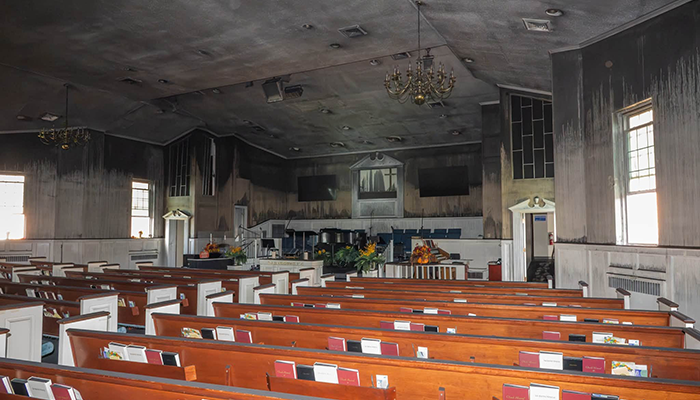
Reading the religion news these days, you could get the impression Christianity is on life support.
Aside from stories about church scandals and political brawls, probably the most constant drumbeat has been the decline of Christianity and rise of the “nones,” or people who say they have no religion.
Digging deeper
But dig a little deeper, and you discover puzzling counterexamples suggesting American Christianity is flourishing. For example, the metropolitan Boston area — not exactly the Bible Belt! — has at least twice as many congregations as it did a half-century ago. Some are Southern Baptist church plants, but many of the booming Boston congregations are immigrant-pastored evangelical and Pentecostal churches.
There are many reasons for concern about contemporary religion, but American Christianity overall is changing, not declining.
Five myths
To shed light on this confusing subject, we want to refute five myths about religion’s collapse.
Myth 1: The nones are taking over American religion
More people tell pollsters today that they have no religion than they did two decades ago. In previous generations, many of these people would have said they were Christians, even if they never went to church.
But a switch from a non-practicing “Christian” to a non-practicing “none” is a change of terminology, not a change in religious behavior. Around two-thirds of Americans still identify as Christians. The rise of the nones is notable, but it indicates less of a change than alarmist news stories would suggest.
Myth 2: The nones are atheists
Nones have the option to check “atheist” or “agnostic,” but instead they choose the (less specific) category of “no religion.” The rates of atheism and agnosticism in America have stayed constant for decades, at about 4% each. The number of people who select “nothing in particular” for religion ascended from 12% in 2007 to 19% by 2024, according to Pew Research data.
Pollsters almost never ask follow-up questions about people’s religious self-identification. When they do, however, they find that the nones overwhelmingly believe in God or a “higher power.”
Surprisingly high numbers of nones also pray or say they’ve had encounters with God or angels. A small but notable number of nones even go to church. Why churchgoing nones say they have no religion is an unexplored mystery of the polling data.
Myth 3: Predictions of Christianity’s demise are new
Fears about religion’s collapse are as old as America itself.
The term “nones” is new, but Americans have used other words in the past that effectively meant the same thing. One of our favorites is “nothingarians,” a term that was used as often in early America as “nones” is today.
Nothingarians were generally people who lived on the frontier, where there were few to no churches. Observers on the East Coast worried these people were destitute of all religion and sinking into paganism.
Ironically, pastors and missionaries sounded alarms about nothingarians even as America was swept into the Second Great Awakening, the greatest era of Christian growth in American history.
Worries about religion’s demise are ever-present, but they usually tell us more about people’s cultural anxieties than they do about actual patterns of Christian decline.
Myth 4: All the data shows religion is declining
Nones have attracted virtually all the media coverage over the past decade. But an arguably more important trend is the rise of the “others.”
This little-noticed but prodigious wave is suggested by the proliferating congregations in Boston. We have hard data showing that surveyors and journalists undercount the total number of American churches by at least 25%.
By conservative estimates, this means there are tens of thousands of churches and tens of millions of American Christians who are nowhere on journalists’ radar screen.
How could they miss such a huge cohort? It’s a case of “you don’t know what you don’t know.” As American religion changes, there are countless new churches, and even new denominations, which don’t get surveyed because demographers don’t know they exist. If all you hear about is nones, you don’t go looking for others.
The others are disproportionately evangelical or Pentecostal, and they are often ethnic minorities and recent immigrants. Sometimes they meet in small storefronts, but sometimes they are in highly visible megachurches.
They are the future of American Christianity. But for the media’s purposes, they might as well not exist.
Myth 5: Religion doesn’t make a big difference anyway
Churchgoers regularly hear claims like “church people get divorced at the same rate as unchurched people.” The problem is there’s absolutely no empirical evidence to back up this claim about divorce and religion.
In fact, religious practice is correlated with positive outcomes in all major areas of human flourishing, from family life to physical health and financial stability.
We know much more about the healthy effects of religion because of the Global Flourishing Study (GFS), a landmark project led by researchers from Baylor and Harvard universities. (Byron is one of the co-directors of this study.)
This massive $48 million project has empaneled more than 200,000 adults in more than 20 countries around the world, seeking to discern the factors that lead to human flourishing.
GFS data shows conclusively that religiously active Americans do better than irreligious and nominally religious Americans across a wide range of categories, including rates of anxiety and depression, strength of relationships, and a sense of purpose.
Young people have taken an alarming downturn in levels of anxiety and unhappiness since the advent of social media. But religiously active teens do much better than their nonpracticing peers in terms of supportive relationships and life satisfaction.
We get a steady stream of disturbing anecdotes about young people “deconstructing” today, but GFS data confirms many young people are not leaving their childhood faith. If they persevere, they are better off spiritually and emotionally.
The church and nones today
What can church leaders take from these findings?
First, when a pastor calls on people to commit themselves to the Lord and the local church, he’s not guilt tripping them. He’s throwing them a lifeline amidst the storms of our anxious and depressed culture.
Second, we shouldn’t let gloomy predictions and unfounded statistics shape our view of the church. God is on His throne, and the fate of Christianity is ultimately in His hands. The church is always changing, of course, but by God’s power, “the gates of Hades will not overpower it” (Matthew 16:18, CSB).
EDITOR’S NOTE — This article was written by Byron Johnson and Thomas Kidd and originally appeared published by Lifeway Research.