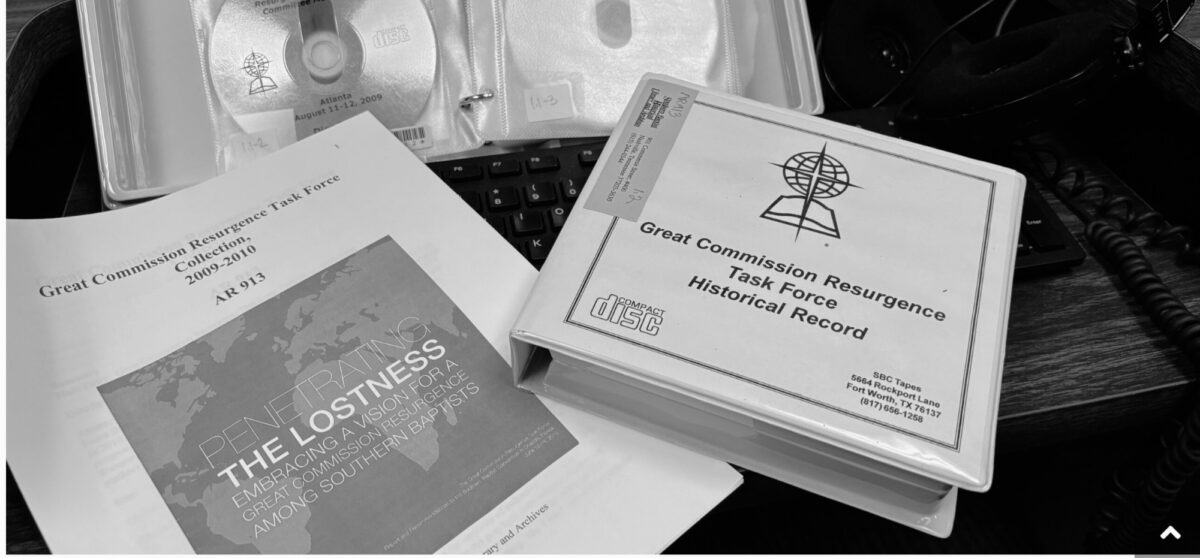
Staff members of The Baptist Paper, a sister publication to The Alabama Baptist and part of TAB Media Group, continue their review of the audio files from the 2009–2010 meetings of the Great Commission Resurgence Task Force. (See first two articles here.) They’ve made it through the third meeting, held at the Dallas Fort Worth International Airport, which took place Oct. 27, 2009. This meeting has been broken up into two parts. Stay tuned for the next report.
For more stories at your doorstep, subscribe to The Baptist Paper.
SIGN UP for our weekly Highlights emails that hit your inbox on Monday, Wednesday and Friday.
A few highlights from the meeting:
• Ronnie Floyd, chair of the task force and then pastor of Cross Church in Springdale, Arkansas, said, “We’re often asked, ‘What is the agenda of the Great Commission Resurgence Task Force?’” That is a “loaded question,” he added.
“It’s almost like the mindset is that we have all gotten in a room and decided we’re going to have an agenda. The agenda has really been passed on to us, and the agenda has been given to us not only by the Southern Baptist Convention, but the agenda most of all has been given to us by Jesus Christ.”
After sharing about Walmart’s success and commitment to growth, Floyd said Southern Baptists should be committed to growing the Kingdom.
“What is our priority? Our priority is to present the gospel of Jesus Christ to every person in the world and make disciples of all the nations. … That’s our agenda.”
Seeking to ‘scare’ and ‘slay’ elephants
• David Hankins, then executive director of the Louisiana Baptist Convention, gave a report to the task force representing state Baptist conventions — with 22 executive directors present in the room. His report focused on the value of state conventions and the need to continue the structure of the Cooperative Program and the partnership — specifically the cooperative financial agreements with the North American Mission Board.
Hankins said he wanted to confront any elephants in the room and “scare them out of hiding and tame them or slay them.”
“None of us are satisfied with the declines in membership and baptisms and missions support. But we have had remarkable results and staying power, even up until today in the Southern Baptist Convention. … We are not at the top of our game, but we are very much in the game. Pronouncements that the SBC is dead are not only premature, they ignore a vast array of data to the contrary.”
Among some of the “affirmations” for state convention work, Hankins noted “the structure that has served Southern Baptists in the past is well suited for the future. … structure is our servant, not our savior.” Citing two surveys — one he had previously commissioned and another the Executive Committee, working with Lifeway Research in 2008, had commissioned — he went on to say Southern Baptists “want a structure.”
Hankins noted, “the rank and file of Southern Baptists are basically happy with allocation decisions.”
“We disagree with those asserting we are using outmoded structures that will not work in the 21st Century. … Whatever failings can be credited to our structure are due less to flaws in the structure and more to neglect of the structure.” He pointed to the Cooperative Program’s ability to unify, cooperate and mobilize “at every level.” Hankins noted the current structure has “boots on the ground everywhere.” He also credited NAMB’s partnership and described the funding that state conventions receive as a “lifeline” to strategy and success, especially in pioneer areas across the country.
Pointing to ‘stewardship problem’
Hankins pointed to a main issue, not being the state conventions and the structure, but church giving. “The allocation problem we have is not between the state conventions and the SBC. It’s between the church member’s pocketbook and the offering plate. Our most serious problem is a financial stewardship problem, which is indicative of a Lordship problem. … We are giving a smaller percentage than the generation of the Great Depression.”
Concluding his report, Hankins summarized that state executives are “very interested in supporting this Great Commission Resurgence process, but not at the price of having our constituents told they ought to devalue our work. … If we do not achieve real partnership, it doesn’t matter how magnificent or inventive our recommendations may be, we will all fail.”
Fielding questions
Following Hankins’ report, Floyd opened the meeting up to questions from the task force.
• J.D. Greear, task force member and pastor of The Summit Church in Raleigh-Durham, North Carolina (and future SBC president), asked why the few Southern Baptist churches that designate their money to SBC entities — but choose to bypass the state convention — couldn’t be counted as a CP cooperating church if most churches reportedly are fine with the current CP structure. Hankins noted he and other state convention executives are convinced that significant changes to the SBC structure — without cooperation — would “accelerate” and “dismantle” the Cooperative Program.
Churches can designate funds now, Hankins added, but it’s counted as designated giving and “not called the Cooperative Program.” He said, “Churches, you are certainly free to do what you want to do, but we unapologetically and enthusiastically ask you to support the whole program. … To have a designated system unravels that. There’s no way to maintain a unified system of funding without a unified system of funding.” Overall, he noted, the SBC will experience significant decline if more Southern Baptist churches bypass parts of the Cooperative Program.
‘Been there before’
• Rick Lance, executive director of the Alabama Baptist State Board of Missions, was among the 22 state convention executive directors in the room. He shared how he had pleaded with Alabama Baptist churches that were “designating around the SBC” not to keep their money in the state. “I said do not do that. Please do not do that. That’s not being family, that’s not reaching the nations.”
Lance said his goal was to get designated giving in his state down to “zero.” Any change to the structure, Lance noted, would cause some people to come back to him and say, “Are you not a hypocrite? You told us not to designate around the SBC, but the SBC is blessing an effort to do that to the state convention. … My sentiment is that if we’re not able to do it together, we’re not going to be able to do it separately.” He added that changing the structure is “not our desired future.”
“We have been there before. Before there was General Motors, we had horses and buggies,” he told the group. “We do not need to go back to horses and buggies, even if we can text each other while we’re doing it. Our desired future ought to be to move together cooperatively, and take as many as we can with us.”
• Hankins, recalling “Planned Growth and Giving,” a previous effort to get more money outside the state, said he’s ready to revisit the idea of state conventions going to a 50/50 split (keeping 50% of funds in the state and sending 50% to SBC causes). “Planned Growth and Giving was Southern Baptists’ attempt to do what I’m recommending today, 25 years ago. It was a dismal failure. Mostly it was a dismal failure because we had bigger fish to fry.”
“We had to get our theological house in order, and it didn’t matter what the giving was if we didn’t know what we believed,” he said. “So it got set on a shelf. … It was gonna move money from the church member’s pockets to the churches, to the Cooperative Program, to the world. That was the dream.”
Two or three conventions went to 50/50, he said, but “the churches didn’t come through” and “we nearly went out of business” and had to back up. “I believe had we not had to stop and take care of our theological issues that it might have been possible. … There was already the mood to do that, to fulfill a dream that started in 1925, we just never have been able to manage.”
Hankins added, “I’m ready, these guys are going to shoot me for saying this, but I’ve been committed to this for a long time.” That means, he clarified, “state conventions are willing to look at what they do, keep their valuable ministries but also be very lean and mean, which we already do. We’re streamlining.” Hankins noted the Louisiana Baptist Convention had 153 employees in 1985, and now has 91. “Could we not give the Cooperative Program one more chance?”
• Al Mohler, president of Southern Baptist Theological Seminary, said when the Cooperative Program was formed in 1925, it was an “experiment in progress, as was the Executive Committee (which was) formed at the same time.”
“It took Southern Baptists some successive years, 25 to 30 to make some adjustments and try to work some things out. But it was an experiment. The levels of percentages were not fixed in stone,” he said. “There were decisions made back then that made a great deal of sense. … The big question I think a lot of people are asking us now. What makes sense today? And all of this conversation is helpful to help bring that into focus.”
‘I have socks older than you’
• Greear asked to hear what state conventions can do better with the money kept in the states that the churches cannot do or the IMB could not do better overseas? He clarified, “I do recognize there are things (state conventions) can do. I just want to be clear to what those are — and help me determine how much budget that’s worth.”
John Sullivan, then executive director-treasurer of the Florida Baptist Convention, who would retire in 2012, offered to respond to Greear’s question. He began by listing off numerous ways Florida Baptists are not only doing international missions, but also addressed what they are doing to address the need for theological education — and how that is a critical need. “Theological education is a passion of mine; we must do that — or we’re going to produce the kind of churches that we simply do not want to produce.
“So I would simply say to you, state convention work we’re doing in Haiti, we’re doing work in Cuba. We’re doing work in Brazil and the Amazon Basin, where they tell us there are probably 30,000 villages that have never heard the name of Jesus Christ. We go and get on a boat and take the jon boats into the little villages, so we’re doing some things that are not being done by the International Mission Board and probably won’t be done by the International Mission Board in some aspects of it.”
As Greear thanked Sullivan for his response, the state exec quipped, “By the way, I have socks older than you.” The room erupted into laughter.
• Danny Akin, task force member and president of Southeastern Baptist Theological Seminary, followed up Sullivan’s response with a report of data from an outside “independent think tank” studying denominational giving. Akin said of “$12 million given by churches last year, 98 cents on every dollar never left the borders of the United States of America.” He added, “That’s an accurate report.”
• Kathy Ferguson, task force member and women’s ministry speaker whose husband, Rick, died seven years earlier, asked Hankins to share more information on his report’s conclusion that most Southern Baptists are pleased with how CP funds are dispersed.
Hankins cited the EC survey that was done two years prior to his report about “90% of laymen who answered the survey on the question about allocations between SBC and state conventions and on other allocations said they thought they were about right.
“Pastors, as I recall, 70% said they thought the allocations were about right,” he said. “11% wanted more to stay in the state convention. And the balance, my math puts that somewhere around 20–25%, wanted more money to go to SBC.”
Ferguson, who had recently married Alabama pastor Ed Litton (a future SBC president), responded: “I just feel like that the grassroots Southern Baptists that were probably never touched by that survey — that understand much about unpenetrated parts of our nation — I just find it hard to believe that those people would be pleased with allocation decisions.”
Hankins countered, “I don’t know what to tell you. It was a bonafide survey done by Ed Stetzer. They stand by the accuracy of it, plus or minus 3% accuracy on a random survey. … All I know to say is we did a survey and that’s what the answer came back.”
• Roger Spradlin, a task force member who died in 2023 and was co-senior pastor of Valley Baptist Church in Bakersfield, California, affirmed the work of state conventions while also pressing Hankins on why not put another CP “hook in the water.” He said this would affirm those churches that want to give more to SBC causes instead of giving to other groups outside the Convention.
Hankins said no one was being forced to do anything, “You don’t make anybody. You prefer. … The SBC and the state conventions prefer the unified plan. Somebody wants to give another way, we’re not going to curse at them. But we just say we prefer. Like these guys mentioned, we say to these folks that want to designate around the SBC. We say we’d rather you not do that. We’re partners.”
‘Lepers’ and a ‘sick’ SBC
• Floyd responded to Hankins noting, “You said you wouldn’t curse them, but they are at times treated like lepers. They’re written about in a negative way, or they’re referred to in a negative way that they’re not quote ‘cooperative Baptists,’ which is ridiculous or they wouldn’t be giving anyway.” Floyd added, “The culture in the SBC is sick. I think it is very 1 Corinthians 3 and rarely 1 Corinthians 13. … I’m talking about in the overall SBC. The culture needs — we call it renewal, revival. Call it what you want, I just call it how to treat people.”
• Mohler addressed what he described as a “polarized” tone of the meeting. He said, “This meeting has been more polarized in spirit — and frankly even in data — than it needed to be.”
“Going out, I just want to tell you … if you left this meeting just based on this conversation, I think you have a false understanding of what we’re all about on both sides,” he said. “I do want to say at the end of the day, what brought about this whole process, a great deal has to do with a younger generation that really isn’t very represented in this discussion.”
Mohler added, “And they’re asking some questions, that I’m thankful they’re asking. They’re looking at a generation of opportunity. They’re looking at the history of the modern missions movement. They’re looking at evangelical Christianity in America, and they’re seeing us failing to live up to what we say we’re all about. … They are being driven by a passion that is far more out there than right here. The biggest problem we face here is we can’t in honesty look to the cross of Christ and say our funding is where it ought to be — either in the aggregate amount or in the percentages. And I’m not looking at you as a state convention and saying it’s your fault. …
“It’s a good reminder to us that we are living with a succession of decisions that the worst of those decisions is at the level of the local church,” he said. “And as a seminary president, I’m not in a position to criticize the local church. But as a theologian, I’ve got to say we’ve got a problem here.”
Looking ahead
Mohler closed the session with state executive directors by noting, “I hope we give leadership to where we’re supposed to be rather than having a generation that decides we’re not only old fashioned, we’re just sinful and missing the point. And I don’t want that to happen. I don’t want that to happen to Southern Seminary. I don’t want that to happen to the SBC. I don’t want it to happen to the state conventions. I don’t want it to happen to any level of Baptist life. And we’re all gonna discover we’re living in a new age whether we like it or not.
“If we’re not as Baptists — as Baptist bodies, entities, systems and structures — the answer to the question that the coming generation is asking, then we will go on but they’re gonna go on without us. And I don’t want to see that happen. I don’t think you do either.”
EDITOR’S NOTE — This report was written and compiled by Shawn Hendricks, content editor for The Baptist Paper.