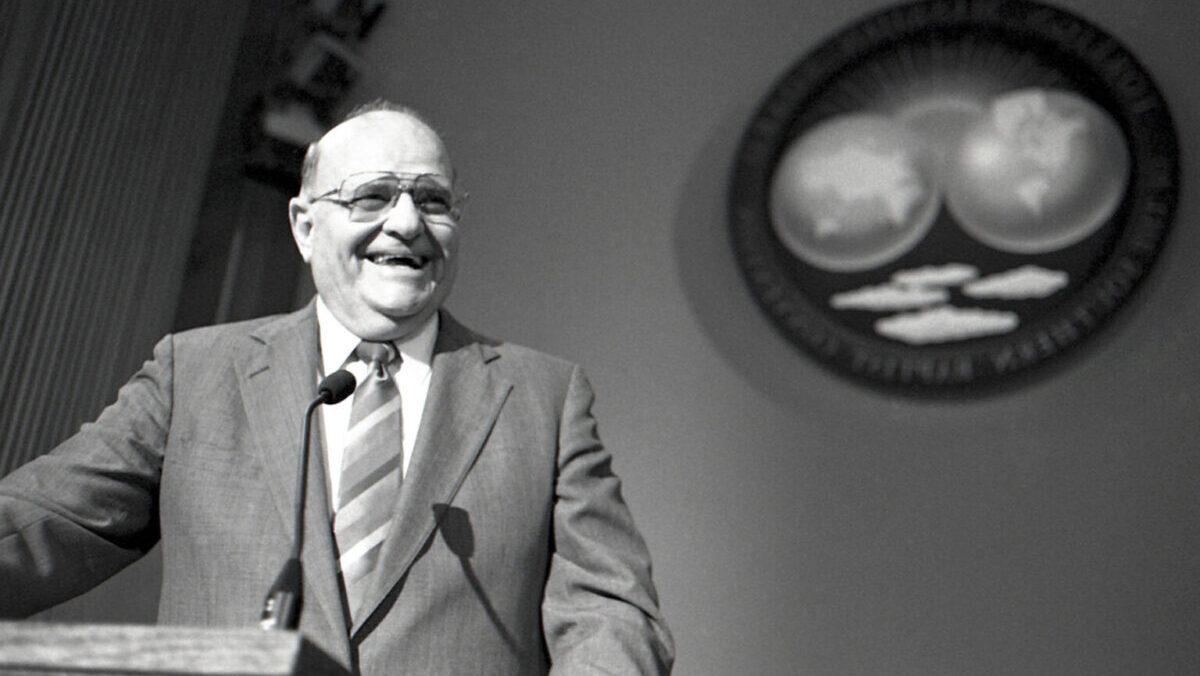
R. Keith Parks, missions leader who played a key role in opening Southern Baptists’ eyes to the millions of unreached peoples worldwide, died Aug. 26. He was 97.
International Mission Board President Paul Chitwood expressed his gratefulness for Parks’ legacy. “We celebrate that Keith Parks and his wife gave decades of their lives to serving Southern Baptists in our cooperative mission work to get the gospel to the nations,” Chitwood said. “While Keith served as president during a complicated time in Southern Baptist life, his intentional focus on taking the gospel to the unengaged is a lasting legacy that still marks IMB strategy to this day. I am grateful for that legacy.”
For more stories at your doorstep, subscribe to The Baptist Paper.
SIGN UP for our weekly Highlights emails that hit your inbox on Monday, Wednesday and Friday.
Parks, a native of Memphis, Texas, got his first taste of international missions as a student summer missionary to Colombia’s San Andrés Island. Thirty years later, when a reporter asked the newly named president of the Southern Baptist Foreign Mission Board to describe himself, Parks responded, “I am a missionary.” That remained his identity until the end.
Parks spent 45 years in international missions, serving as ninth president of the FMB (now IMB) from 1980 to 1992. He and his wife, Helen Jean, were missionaries to Indonesia for 14 years before he joined the home office staff, where he served in several administrative roles.
Todd Lafferty, IMB executive vice president and chief operating officer, also served on the mission field in Indonesia, in addition to other countries, before joining the U.S. staff. Lafferty said, “Keith Parks’ visionary and strategic leadership led us from familiar mission stations to unmarked roads in the missionary task to reach the least reached. His legacy lives on as we continue to seek to reach the remaining unengaged, unreached peoples in the world today.”
Parks retired as FMB president in 1992 and became the first missions coordinator for the Cooperative Baptist Fellowship.
‘Unprecedented era’
“Parks’ leadership thrust the IMB into an unprecedented era of effectiveness toward fulfilling the Great Commission,” said Jerry Rankin, who succeeded Parks as the mission board president.
“Missionary deployment around the world exploded under Parks’ predecessor, Dr. Baker James Cauthen,” Rankin said, “but Parks looked beyond successful growth to see that part of the world still unreached and closed to missionary presence.”
Parks’ presidency at the FMB coincided with world-changing events that brought new dangers — and opportunities — for Christian missionaries: the rapid spread of HIV/AIDS, growing numbers of terrorist attacks and assassinations, the end of apartheid in South Africa, the fall of the Berlin Wall, the Tiananmen Square protests, the dissolution of the Soviet Union and the proliferation of new technologies and birth of the World Wide Web.
Parks’ leadership was a match for the times. Southern Baptists in 1976 had adopted a goal of preaching the gospel to everyone in the world by the end of the century. It fell to Parks to determine what it would take to reach that goal.
The goal has yet to be reached, but research into what it would take yielded “crushing statistical evidence that without an enlarged vision of the world, Southern Baptists would never contribute their full share to global evangelization,” wrote Leland Webb, editor of the FMB’s The Commission magazine at Parks’ retirement.
What the research revealed was more than 6,000 unreached peoples, ethnolinguistic groups who lived with few, if any, Christians among them, had little or no access to Scripture and did not welcome missionaries. The 1.9 billion people in those groups would likely never hear the name of Jesus.
“Keith Parks was a missiologist par excellence,” Clyde Meador once said of Parks. “He would do what he saw as right whether it was popular or not.” Meador filled several key roles, including executive vice president, at the IMB before his death in 2024.
New strategies
What Parks did was urge missionaries to develop daring new strategies to reach the unreached. This gave birth in 1985 to Cooperative Services International, which assigned teachers, doctors, businessmen and humanitarian workers to countries closed to traditional missionaries. Later, the nonresidential missionary program was born for missionaries to develop creative ways to reach unreached people they could not live among.
“Parks’ vision positioned Southern Baptists to respond to the fall of the Soviet Union and laid the groundwork for changes that followed his tenure to focus on people groups instead of countries and engaging the unreached,” Rankin said.
Parks also challenged Southern Baptists to consider countries where missionaries had long worked as partners in reaching the world. On his last overseas trip as FMB president, to participate in a meeting of Baptist leaders from across the Americas, Parks challenged participants to begin sending their own missionaries as partners in God’s mission.
“Too many Christians in this world are convinced their responsibility is only to the people of their culture and language,” Parks said. “We’ll never reach the world for Christ if we restrict ourselves to our own language and culture. Local interest always wins when culture dominates Christianity. Global interest wins when Christianity dominates culture.”
See related story by the Baptist Standard.
EDITOR’S NOTE — This story was written by Mary Jane Welch and originally published by the International Mission Board.