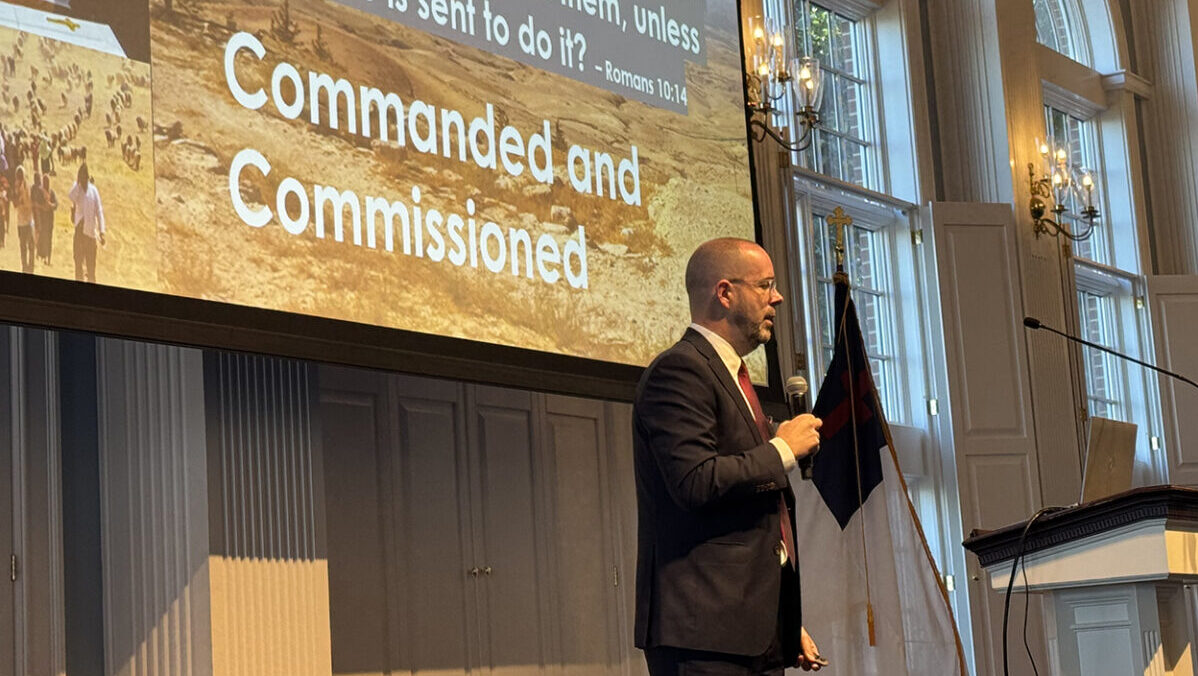
Christians are commanded, commissioned and called to combat all religious persecution, international human rights attorney Knox Thames told a gathering at Dallas Baptist University.
Two-thirds of the global population live in countries that restrict the free practice of faith, Thames informed the Global Religious Freedom Gathering, sponsored by Christians Against All Persecution and DBU’s Center for Global Religious Freedom.
For more stories at your doorstep, subscribe to The Baptist Paper.
SIGN UP for our weekly Highlights emails.
Thames, author of “Ending Persecution: Charting the Path to Global Religious Freedom,” distinguished genuine persecution from the loss of privileged status enjoyed by a specific group.
“Persecution is violence or severe punishment on account of victims’ belief or non-beliefs or membership — real or perceived — in a religious community, combined with a lack of accountability,” he said.
Thames identified four forms of persecution:
— Authoritarian persecution occurs when the state exercises power against religious activity or religious groups, such as in China.
— Extremist persecution takes place when non-state actors and individuals are allowed to commit acts of violence against those who practice a particular religion or fail to adhere to the state-sanctioned religion, such as in Pakistan.
— Terrorist persecution occurs when extremist groups commit acts of extreme violence against particular religious groups, such as ISIS targeting Yazidis and Christians in Iraq.
— Democratic persecution happens when the dominant religious community uses majority rule to trample the rights of adherents of minority religions, such as in India.
The global “pandemic of persecution” does not affect followers of only one religion, said Thames, senior fellow at Pepperdine University.
Rather, it “goes after everyone” and endangers freedom of thought and practice of all wherever it occurs, he stressed.
‘Be light in the darkness’
Christians have the responsibility to pray for all persecuted people and advocate for the religious freedom of every person, Thames emphasized.
“Advocacy demonstrates God’s love in a tangible way,” he said.
Jesus commanded his followers to love their neighbors and commissioned them to make disciples of all people groups everywhere — not just those who are like them, Thames said.
Citing both the Hebrew prophets and the New Testament, he pointed to ways God calls his people to stand up for the rights of the oppressed and vulnerable.
“One small light can pierce the darkness,” Thames said. “We are called to be light in darkness.”
During the gathering at DBU, participants not only prayed for a Christian pastor from Turkey and a Nigerian pastor, but also a representative of Pakistan’s Ahmadiyya Muslim community and a Shia Muslim from the Hazara people of Afghanistan.
Lead with love, start with service
Non-Christians find the gospel more compelling when Christians lead with love and start with service, rather than seek power and exercise privilege, former Houston pastor Steve Bezner said.
Bezner, now associate professor at Baylor University’s Truett Theological Seminary, spoke in the DBU chapel service during the Global Religious Freedom Gathering.
History, diplomacy and theology should lead Baptists in the United States to care about religious persecution and advocate for the religious freedom of all people, he said.
Baptists in colonial America learned early what it meant to be “on the receiving end of persecution,” said Bezner, citing pastors Roger Williams, Obadiah Holmes and Isaac Backus as examples.
On a practical level today, when Christians in the United States insist on religious freedom for all people domestically, appeals by U.S. diplomats for international human rights carry greater weight, he added.
Theologically, true faith demands the freedom to choose freely, not coerced conformity to mandated religion, said Bezner, author of “Your Jesus is Too American: Calling the Church to Reclaim Kingdom Values Over the American Dream.”
“Jesus wants all to freely come to him,” he said.
Establish relationships
Bezner recalled the backlash against Muslims when an Islamist extremist killed 49 people and wounded 58 others at the Pulse nightclub in Orlando in 2016 — the deadliest mass shooting in American history up to that point.
At the time, Bezner had been pastor of Houston Northwest Church about three years. He felt God leading him to stop at a Houston mosque in the immediate aftermath of the mass shooting and seek to befriend the imam there.
A frank and honest exchange — in which the pastor and the imam each affirmed their distinctive beliefs — provided the foundation for mutual respect and resulted in Bezner receiving invitations to speak at three local mosques.
“The gospel runs on the rail of relationships,” he said.
He also described how members of Houston Northwest Church spent two months in “mud-out” work after Hurricane Harvey hit their city in August 2017.
Church volunteers worked in the flooded homes of their neighbors — many of them non-Christians — clearing out mud, discarding debris, removing damaged drywall and disinfecting surfaces to eliminate mold.
Peacemaking group receives award
The Global Religious Freedom Gathering at DBU also featured panel discussions involving pastors, international students and advocates from human rights groups focused on religious freedom.
At a dinner held in conjunction with the gathering, the 21Wilberforce human rights organization presented its annual Frank Wolf International Freedom Award to Mae Elise Cannon, executive director of Christians for Middle East Peace.
The coalition — representing more than 30 national communions and organizations — mobilizes Christians in the United States to advocate holistically for equality, human rights, security and justice for Israelis, Palestinians and all people of the Middle East.
Previous award recipients include Bob Roberts, co-founder of the Multi-Faith Neighbors Network; Bob Fu, founder of ChinaAid; Sam Brownback, former U.S. ambassador-at-large for international religious freedom; Archbishop Ben Kwashi and Gloria Kwashi of Nigeria; and the city of Midland.
EDITOR’S NOTE — This story was written by Ken Camp and originally published by Baptist Standard.