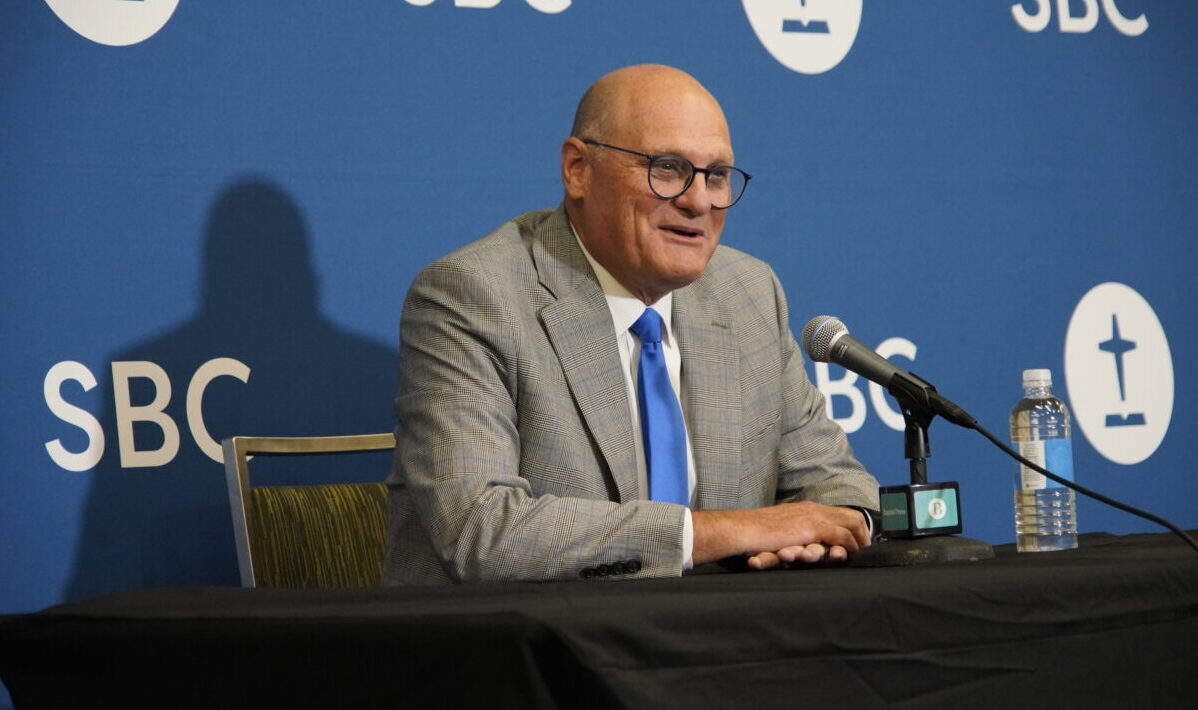
Willy Rice is focused on late September. At the time the newly-elected president of the Southern Baptist Convention talked with the Illinois Baptist, he was on a brief trip, gathering his thoughts and outlining his first address to the SBC’s Executive Committee next month.
In our conversation, it’s clear that Rice feels the weight of passing the Truth and Unity (Mohler) Amendment which will come for a second vote in Indianapolis in June 2027, the same city where a similar amendment to the SBC Constitution limiting the pastoral office to men failed to receive the required two-thirds majority vote.
Plans for the year
“It’s not finished,” Rice said. He wants leaders “rowing in the same direction” so the Amendment can be passed and the Convention can focus on its missions commitment. The Florida pastor says he will spend his first year answering questions about limitations on the use of the word pastor and firming up “broad convictional consensus.”
He has other plans too. While not tipping his hand completely, Rice spoke about an evangelistic “thrust” tied to the coming 2,000th anniversary of the Great Commission that could unify Southern Baptists afresh around missions and evangelism for the next generation.
Rice also talked about God’s timing in the four-year delay in his election, and debate over bringing SBC Annual Meetings to the Midwest and places outside the deep South.
This interview with editor Eric Reed was edited for brevity and space.
You’re just over one month into your first term: is your phone ringing a lot? Are you feeling the weight of the work that’s ahead?
Rice: Out of the gate, I’m very excited. And you’re right, the phone is ringing. You know, there’s a lot of opportunities. People are asking me to come and speak. We’re also trying to get our work organized. I came in with some very clear ideas in mind, so now it’s about how to formulate that into specific strategies.
I’ve had a lot of conversations with the entity heads, but a first step is getting ready for the Executive Committee in September. I view that address as an opportunity to lay out several specific ideas that I have, things that I will need their help on, things that I will call Southern Baptists to. And so the first stage is turning dreams and visionary statements into action plans.
Is there anything that you might want us to hear a little bit about before September?
One is the ongoing issue of the Truth and Unity Amendment, which is an issue that, you know, is going to have to be solved in the sense of how we achieve broad, vast, convictional consensus.
I really believe there is consensus that Southern Baptists have [but] there are legitimate questions about what certain things mean and how certain things will be applied. What are the unintended consequences?
If we can find our way through some of the maze of that, I do think we can achieve a vast convictional consensus.
Have we not done that by passing this amendment in Orlando by nearly 75% approval in the first vote?
Yes, I think we’ve taken a big step forward, a big step forward. But as everyone knows, it has to be passed a second time.
I’m listening to people in that 25% or so [who voted against the amendment], I’m trying to do what I would want them to do for me if the shoe was on the other foot. I think there are some legitimate questions that need to be clarified. My goal will be to move [support] from 75% in the affirmative to like 90% in the affirmative.
I hope by the time we get to Indianapolis, everybody goes, “Okay, that’s what they mean; that’s what they don’t mean; that’s how this is going to be used.” And I hope that we can finish the job.
What is the mechanism for doing that? Because you might have thought coming into office that you’d have a task force or a study group, right? A mandate to address the role of women in church life. But nine task forces got quashed with a single vote.
Well, I think I have a way. That’s probably part of what I will share in September. But you’re right, admittedly there was task force fatigue. The messengers had kind of learned that if you want to accomplish something, appoint a task force. Everyone was getting a little tired of that, and I understood that entirely.
While I’ve adjusted, you know, my plan and strategy, I do believe there are some ways that we can clarify for everyone so that the Baptist on the back row knows what we mean.
Can the president appoint ad hoc committees of his own choosing and purposes?
Yes. There’s precedent for that — a tool the SBC president has at his disposal.
You also have the meeting of the minds that happens with entity heads and seminary presidents where this kind of coalescing of support could happen.
The entity heads do occasionally meet. They’re always talking to one another. I would think if you want to present something to that group, it’s really helpful if we can get everybody rowing in the same direction on an issue like this. Just to be honest, that wasn’t the case in the past. We had people kind of pulling in different directions.
People have asked us about expansion of the Mohler Amendment to include the roles of women in positions other than pastor, and using that to withdraw fellowship from some churches. But Dr. Mohler said in Orlando he did not believe the Convention had intention to expand use of this amendment. Is that what you want to answer before we get to Indianapolis?
I would say yes. I want to answer the questions of anyone who may be may be imagining a worst-case scenario or a draconian enforcement. I want to answer the good faith questions. There are always people who can imagine draconian things in order to instill fear or to move their own agenda. But my goal will be that by the time we get to Indianapolis, the only way you would vote “no” on this is that you really do want women pastors.
I’m not in any way impugning someone’s motives who may disagree with me. I’m just saying my goal is to be so exceedingly clear that that’s really the only reasonable explanation somebody could give to vote against the constitutional amendment. I hope to get there. We’ll see if we do.
In your understanding, any pastoral position as applied to a woman would be inappropriate— including associate pastor?
The challenge in answering that question is the term pastor. We have people using the title to mean different things. And really, it’s a rather modern phenomenon.
I like to go back and say my grandmother knew what a pastor was. She knew the pastor was a guy who preached on Sunday and helped lead the church. Maybe there would be an associate pastor if the church got a little bit large, but you didn’t hand out the pastor title to the minister of youth or the minister of music.
We had an inflationary use of the term [with] massive staffs and megachurches, and then we started handing the title pastor out to everyone. The only way we’re going to get out of this is that we appeal to people to use that term in a way that is biblically appropriate.
Let’s talk about the Midwest. Are you concerned that coming to Indianapolis might present a challenge for approval of the Mohler amendment?
Yes, it’s a concern. I’m not up at night over it, but it’s a concern. I spoke about the issue of annual meeting locations this spring and created a little bit of controversy and got, you know, misunderstood some.
I love Indianapolis. It’s a great city, as is St. Louis. And I think the convention ought to move around in a regular rotation outside the South and to the north and to the west. My concern was the frequency, where I looked at the next decade and I saw we were coming to the Deep South only once, and yet we were voting to go to Anaheim twice in a five-year period.
Somewhere around 80% of Southern Baptist people live in the Deep South and in Texas. The statistics have borne out most people are going to drive from about five hours away. When you move it outside our geographic footprint to the north and to the west, it means you are going to have a smaller convention.
When you have a smaller convention, the percentage of people at that convention who are employed by SBC entities, that is, who are paid to go, is going to increase. So you are going to get a more institutional expression and a little bit less of a grassroots expression.
Is there value at times in having the convention in a place where it actually draws the denomination’s attention to that area. You know, the convention was held in Chicago twice in the 1950s. That brought some significant missions engagement in Illinois.
Absolutely. I think there is value there. I want Baptists around the country to know they are valued. We want to be a national and international movement. We are not simply a parochial movement in the South. I just think there needs to be balance there. (And I look forward to coming to the Midwest.)
You were briefly in consideration for SBC president in 2022, then withdrew. Might this be a better time for you to serve?
When you’re on the backside of God’s timing, it’s easier to see that was part of God’s sovereignty. I can only speak for how I feel, but I just feel so much more prepared to lead in this moment than I would have four years ago. I’m more ready to try to bring about some renewal and some change.
We’ve come through some controversies [as a denomination]. We see some things in a clearer way. And I just feel like, you know, in God’s good timing, this is the right time.
The 2,000th anniversary of the Great Commission is coming up — although the exact date may not be certain. Is that on your list?
A: In the next decade we will pass that mark when Jesus gave his final instructions. Many Christians are circling May 2033 as a way of fixing a date on it. I feel like this is an opportunity for a generational initiative to pursue the Great Commission.
By the end of my presidency, I would hope this is something Southern Baptists around the country are talking about. And I would hope we could cast a vision for what that generational thrust would look like in the United States and globally. So, we’ve got a lot of work to do, a lot of groundwork to lay.
Some of us remember Bold Mission Thrust. How can you make sure the SBC follows through on such a commitment?
It’s a generational challenge. It’s the biggest challenge imaginable. It’s the task that Jesus gave us, and it is impossible. And yet, imagine how impossible it must have sounded to those first disciples when Jesus laid it out — no technology or transportation like we have, and yet he gives them this mission to go to the ends of the earth. It seems so impossible, and yet is it? Nothing’s impossible with God.
That could be a goal that catalyzes us and motivates us, and that’s what I hope.
EDITOR’S NOTE — This story was written by Eric Reed and originally published by the Illinois Baptist.