
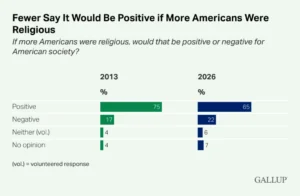
Most U.S. adults believe the country would benefit from having a little more religion, but their number is falling.
In a 2026 Gallup study, 65% of Americans say it would be positive for society if more of their fellow citizens were religious, down from 75% in 2013. Currently, 22% believe increased religiosity across the country would be a negative, up from 17% more than a decade ago.
Some demographic groups are less likely than others to view growth in religion as a positive in the U.S.
RELATED: Check out more studies on faith and culture.
Both men and women saw declines in the percentage who believe more religious people would be a positive for the country, but the drop among women was substantially larger. As church leaders discuss the potential shrinking gender gap, they should consider that women may be growing more distrustful of organized religion.
In 2013, women were more likely than men to say the nation would benefit from more citizens being more religious (77% to 73%). Today, that has flipped. Men only dropped 3 percentage points to 70%, while women fell by 16 to 61%.
Similarly, Americans 55 and older saw a decline from 80% who viewed more religious Americans as positive for society in 2013 to 75% today. Younger adults had much more precipitous falls. Those 35-54 years old dropped from a similar 80% in 2013 to 66%, while adults 34 and younger fell from 65% to 49%.
Politically, Independents, down 12 points from 71% to 59%, and Democrats, down 16 points from 67% to 51%, differ dramatically from Republicans. In 2013, 91% of those aligned with the GOP felt an increase in religious Americans would benefit the nation. In 2026, the percentage of Republicans who felt so actually increased 3 points to 94%.
Belief in the potential positive impact of religion fell across all education levels, but this belief among those with the least formal education, high school or less, fell the least — 79% to 72%.
Additionally, every level of church attendance grew less likely to view an increase in religious Americans as a positive. Among those who attend every week, 89% say it would be better for the country if more people were religious, a 5-point drop. Belief among those who attend monthly to nearly every week fell from 87% to 78%, while a similar 8-point drop occurred among those who seldom or never attend (58% to 50%).
The percentage of Protestant and nondenominational Christians who believe more religious Americans would be a positive development fell from 88% to 81%. Catholics, on the other hand, increased from 80% to 85%.
While non-religious Americans are the only major subgroup in which a majority believes increased religiousness would be a negative (55%), the percentage of nones who say it would be a positive grew from 24% to 27%.
Growing religious influence
Currently, 39% of Americans believe religious influence on American life is increasing, one of the highest levels in recent memory. In the past two decades, this belief has only been higher twice — 41% in December 2025 and 40% in September 2006.
The highest levels came in December 2001 (71%), just months after the 9/11 terrorist attacks, and in 1957 (69%), the first time Gallup asked the question.
Still, in 2026, most Americans (56%) believe religion is losing influence on the culture. But just five years ago, 82% of U.S. adults believed that to be the case.
Government morality
In 2026, more than 2 in 3 Americans (69%) believe government policies have a significant effect on the moral values of the people in the country, while 27% disagree. Those who feel that is true are significantly higher than those who agreed in 2006 (59%) and 1996 (58%).
Americans are more divided over whether the federal government should be involved in promoting moral values in society. Today, 50% say that should not be the case, while 45% say the government should be involved. In 1996, 38% didn’t want the government involved, while 60% said it should promote moral values.
EDITOR’S NOTE — This story was written by Aaron Earls and originally published by Lifeway Research.