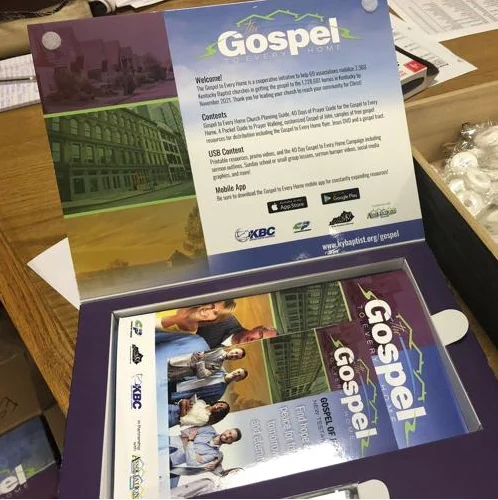
The “Gospel to Every Home” initiative by the Kentucky Baptist Convention was unveiled in 2020, but it is still reaping Kingdom benefits in a rural church near Winchester.
Paul Jorgensen, pastor of Allansville Baptist Church in Winchester, Kentucky, said his church recently completed a three-year endeavor to take the gospel to every one of the 600 homes in the Pinchem precinct.
“During that time, our church grew from almost closing with an average of 35 attendees to now averaging 65,” Jorgensen said. In his three years as the pastor, the church has had 34 salvations, 20 baptisms and 31 new members. It is also one of the top 100 sending churches in Kentucky. It has 146 members in “watch care” — which includes shut-ins and all who visit the church with regularity but are not members.
‘Evangelism still works’
“Evangelism still works,” Jorgensen said. “It is not always the people who whose door you knock on who come to church. God sends people to that church. When a church is busy sharing the gospel, God sends people to that church.”
“Growing up my pastor would tell the story of a drunkard who lived down the road from the church, and his son would sit cowering in a corner wondering why someone wouldn’t come to ask his dad about being a Christian. Every single home should be able to have somebody stop by, care for you and pray for you … and explain how the gospel can change your life.”
Revitalization effort
When Jorgensen took the lead pastor position in 2023 at Allansville, he knew it was a revitalization effort.
“Part of my preaching would include evangelism with some regularity,” he said. “I mentioned the Gospel to Every Home program, which we had done prior to and during Covid in our previous church (Anchor Baptist in Lexington). During that time our church grew, so I thought let’s do that again.”
Considering the biblical teaching that there is “nothing new under the sun” (Eccl. 1:9), Jorgensen contacted the Kentucky Baptist Convention for resources.
“People there, including Todd Gray, Rob Patterson, Andy McDonald and Kenny Rager, located materials for us to use,” he said. “We printed some personal stuff from our church, then we handed out maps and started door knocking. Andy McDonald did door-to-door evangelism training and I did a series on personal evangelism where we covered several different methods.”
Jorgensen observed that he had grown up doing evangelism in the projects of Chicago, but “it was very different here. I thought we could cover it in one summer, but it didn’t work that way. The folks in our church were excited — the first summer some went out every week to knock on doors. The second summer (2025) we chose to do it the last Sunday night of every month, and that allowed us to get a much bigger group to go out. We offered to have prayer with anyone who requested it and we would follow up with those people.”
Opportunity
Jorgensen said the church “has had some amazing experiences” during this effort. “It is an opportunity to get out and be a help to people. A lot of folks are surprised — a lot tell me they never had a pastor come to their place, there was never a visit. To me that is shocking, but homes can be hard to find — you have to want to go there.”
Some of the visits involved traveling down a gravel or mud road a mile or more to find a house.
“We went to one house that had been built around 1780. No one was there, but as we were leaving, a truck was coming down the road. In that truck was a man and his young adult son, and they asked what we were doing,” he noted. “I introduced myself and invited them to church.” The son told the father they needed to get back in church, but didn’t know where to go. They did visit the church and joined and then encouraged other family members to attend.
The father related that Jorgensen “was the only pastor to ever set foot in that home.” It was a place where there are blood stains from when it was used as a Civil War hospital, and you could see where muskets were hung.
“We found that a lot of good people who don’t go to church anywhere and they were shocked to see somebody. One man met me with a handgun at his side and asked where I was doing there. I told him I was from church and he said, ‘prove it.’ I talked about Jesus.” The man then said he was sorry he came out with a gun. “We had a great conversation, but he goes to church somewhere else.”
Process
Jorgensen said this type of revitalization effort typically is a 10-year process. “We are three years into it and having a lot of fun. We had a new guest on Sunday, and I’ve had five people ask to see me this week to talk about personal stuff.
“I am thankful for the KBC’s leadership and encouragement and all the resources we got and were able to hand out for free. Our church people rallied around this and decided to do the trainings and learn how to share the gospel. It’s not just me — it’s the people who are also excited.”
He tells of one church member who has longtime involvement in WMU, who told him, “I don’t think I ever thought of taking the gospel right here — it was always over there. I really like this,” she said, “it is exciting.”
The county lists the Pinchem precinct population at 1,440, “so roughly 10% of people in our precinct are under active watch care,” Jorgensen said. “We’re a tiny country rural church, but actually ministering to about 10 percent of our precinct. These are people we are praying over and have been to our church.”
EDITOR’S NOTE — This story was written by Chip Hutcheson and originally published by Kentucky Today.