In recent decades, there has been a revolution in how Protestants worship.
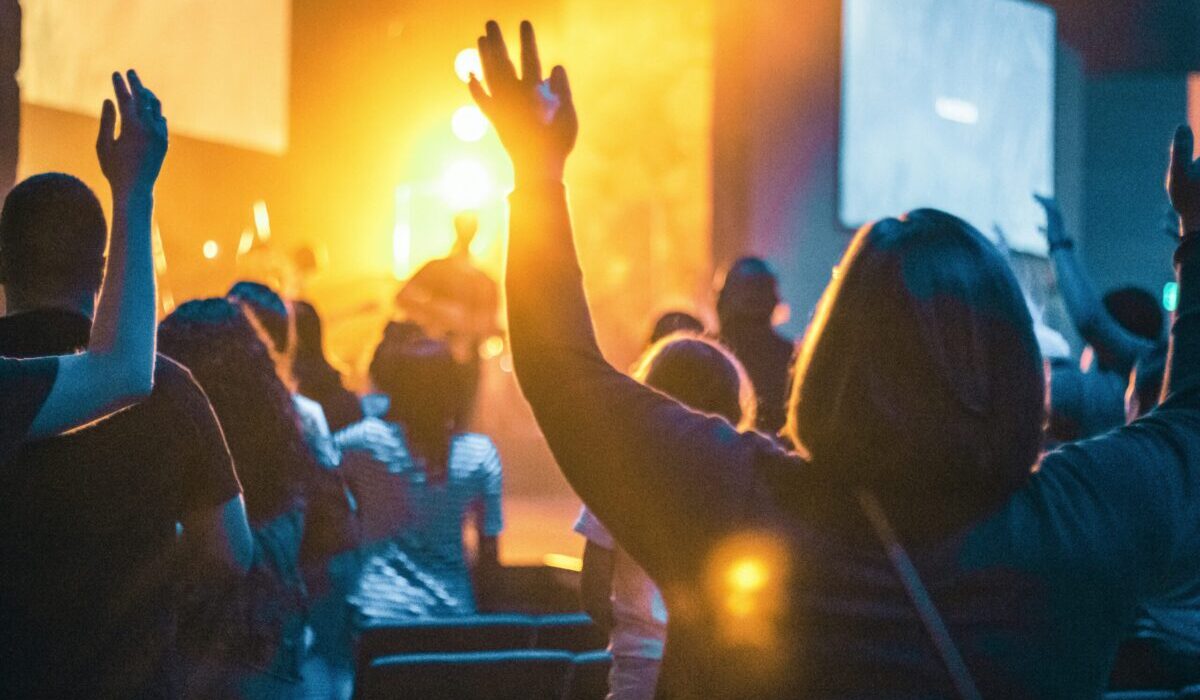
Services were once centered around prayer, hymns, a sermon and the Lord’s Supper, also known as Communion. Now, many worship services resemble a Coldplay concert followed by a TED Talk — a long worship song set followed by a topical sermon with slides.
And worship songs have become a primary way people experience God.
Stay updated on stories like this — Get news delivered to your inbox
This reality led Paul Ryan, a worship pastor at Calvin University and staffer at the Calvin Institute for Christian Worship, to ask a complicated question. If Jesus were preaching today, would he still take up bread and a cup of wine and say, “Do this in remembrance of me” as he did in the Bible?
“Or would he pick up his acoustic guitar and say, ‘Sing this in remembrance of me?’” asked Ryan, during a meeting of worship scholars in Nashville earlier this summer.
The question came up during a talk by Emily Snider Andrews, a scholar at Samford University in Alabama, about the way praise music can make God “experientially real for participants.” Ryan said that scholars have struggled to find the right language to talk about what happens when people sing in modern worship services. Those churches aren’t intentionally trying to replace Communion, the ritual where Christians recount Jesus’ last supper with his disciples and his death on the cross. But something powerful and different is happening in the way people worship.
The discussion of whether worship music has become a new sacrament was one of about two dozen discussions at the two-day Conference on Contemporary Praise and Worship, held July 28–29 at Belmont University in Nashville.
During the event, scholars discussed the theology and history of worship music, talked about the role money plays in shaping worship, and even whether worship music could benefit from an “oldies category” the way that rock music has. They listened to keynotes from speakers like Melanie Ross, associate professor of liturgical studies at the Yale Institute of Sacred Music, and spent a lot of time eating together and talking about what they’d heard.
One thing was notably missing from the agenda: The 60 or so scholars who attended the event did not sing.
Bigger picture
That was on purpose, said Adam Perez, assistant professor of worship studies at Belmont, who was one of the conference organizers. Most conferences that focus on praise and worship music are for church leaders, he said, and focus on learning new songs or getting practical tips for worship.
The focus of this conference, one of the first of its kind, was more on the bigger picture — about what the rise of modern worship music means and how it is changing the church. He said that this kind of music has played a major role in reshaping the American religious landscape. But few scholars talk about it.
“How is it that very few people are talking about it?” he said.
Perez said scholars who focus on contemporary praise music have gathered together before, but usually at a conference with a larger focus, such as the American Academy of Religion or the American Musicological Society, where this topic is just one of many.
“There are not many places where it’s just assumed that this matters,” he said. “We start with the assumption that everybody agrees this phenomenon is worth studying.”
Perez is also part of the Worship Leader Research Project, which studies the songs in churches and who writes them — as well as surveying worship leaders.
While worship music has crossed over to politics and into pop culture, most of the discussion about it is still focused among churchgoers, who make up a relatively small part of the American public. That’s why some scholars may have missed its significance, said Perez.
“For certain Christians,” he said, “this is everything. For a lot of the rest of the people, this is just totally invisible.”
The conference led off with a panel of industry insiders for wide-ranging and sometimes frank talk about music, data, economics and the sometimes-messy lives of songwriters.
Looking at ‘big data’
One of the big questions: How does big data affect worship songs?
Not too much, said Stacey Willbur of TIM Publishing, a company started by famed worship leaders Chris Tomlin and Jason Ingram. Willbur said that, while publishers spend a lot of time sifting through data, she prefers that songwriters spend more time praying and reading the Bible and thinking about the people in churches who might sing that song.
Once the songs are written, data does play a role. And so does money, said Jimi Williams, president of Jesus Culture Music. Williams, a longtime music industry staffer, told attendees that when he worked for Capital Christian Music, which is owned by Universal Music Group, every year he’d get a budget revenue number.
“We don’t care who you get it from,” he recalled his bosses saying. “Just go find it. But you are going to hit that number.”
Jamie Rogers of Capital Music Group said she balances two kinds of success — both financial and spiritual. She wants the musicians she works with to fulfill their calling to write worship music. And she wants to help churches. But she also has to pay the bills.
“We’re not evil business people,” she said. “I want this music to go far and wide for the Kingdom, just as much as you.”
Rogers said that it is easy to be misled by data and to use it as a crutch, rather than a tool. The magic, she said, is still in the creative minds of musicians who write songs. And you never know what song will be a hit.
Ross, professor at the Yale Institute of Sacred Music, made that point in her keynote address, entitled “Everything new is old again,” which compared changes in the church music business, from the 1920s to 1960s to contemporary trends.
In the 1950s, Ross told attendees, a Catholic housewife from Cincinnati named Gladys Gollahon inadvertently invented a new music genre. Sitting at home, Gollahon wrote and recorded a song called “Our Lady of Fatima,” and sent it to a local disk jockey who put it on the air. It was a hit in her hometown, and before long, stars like Tony Bennett recorded their own versions.
That led to a whole host of faith-based pop hits, like “Angels in the Sky” by the Crew Cuts, “The Bible Tells Me So” by Don Cornell and “Peace in the Valley” from Elvis, as secular music publishers began to realize that there was money to be made by promoting religious songs.
Criticism
Not everyone was thrilled by the commercial success of Christian songs on the radio, or by what were then called “gospel hymns” — catchy and emotionally engaging tunes meant to be sung at revivals and church services.
Author and pastor A.W. Tozer was no fan of these modern songs. He felt the music of the church was being cheapened by pop sentimentality — a criticism modern worship songs face today. “For they’re all cheap, and they’re borrowed from Tin Pan Alley,” he wrote in 1953. “And if you would merely change the name Jesus and put the name Frankie Sinatra or Clark Gable in, you wouldn’t know the difference.”
Ross went on to explain that economics have always shaped the songs that churches sang. While church leaders often evaluate the music and theology of hymns, those were the only criteria. Songs are expensive to publish, especially newer songs that might not have a long shelf life.
“The repertoire that denominational editors preferred also happened to be the repertoire that was the least expensive to publish,” Ross said. “I think that alignment deserves more attention than it usually receives.”
During at least one session, scholars learned something new about recent trends in worship music. During a discussion of nostalgia in music, one of the scholars pointed to an incident that occurred during the 2024 Passion Conference for college students.
Improvising at Asbury College
At the conference, the students sang “Agnus Dei,” a popular worship song by Michael W. Smith, for about 20 minutes, led by vocals on a simple stage at a stadium. That approach had been inspired by a similar event at Asbury College a year earlier, where students sang worship songs around the clock for days on a similar simple chapel stage. That event was in contrast to the highly produced worship at megachurches, which often features light shows and even fog machines.
Josh Sadlon, a worship pastor who works with Alliance Worship, part of the Christian and Missionary Alliance denomination, was at the Asbury Revival. He said that people often point to the lack of production at the revival as something special.
But that was born of necessity, he said. The students wanted to keep singing, but the staff who ran sound at the college had to go home. So they had to improvise.
“It was just the fact that no one had keys to the sound booth,” he said.
EDITOR’S NOTE — This story was written by Bob Smietana and originally published by Religion News Service.