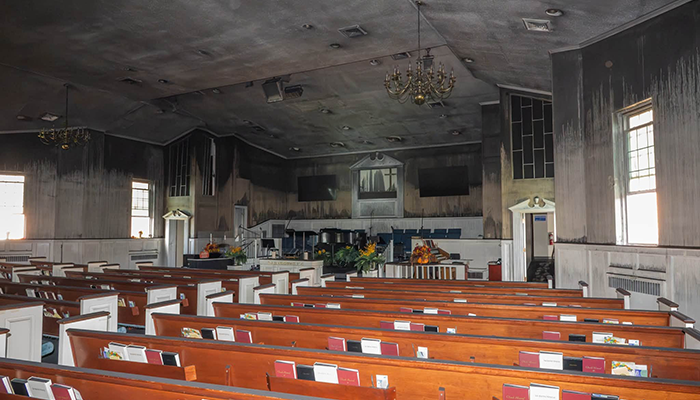
When it comes to going to church, a generational pattern is playing out in many households around the world: Grandparents never miss Sunday service; parents attend only on holidays; children, who describe themselves as “spiritual but not religious,” rarely attend at all as adults.
A new study, published in August in the journal Nature Communications and conducted by researchers at the University of Lausanne, Oxford University and the Pew Research Center, sought to explain the ebbing of religiosity across generations.
For more stories at your doorstep, subscribe to The Baptist Paper.
SIGN UP for our weekly Highlights emails.
Drawing on data from Pew, the World Values Survey and the European Values Study, the authors looked at secularization and religious change across more than 100 countries and major religious traditions.
“We hope this article is useful as a kind of grand narrative about what’s going on in the world, a model of how to see global religious change,” Conrad Hackett, one of the authors, told RNS.
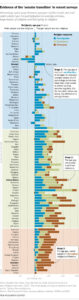
The researchers describe a sequence in how religious life tends to decline across generations. First, participation in worship services drops. Next, people report that religion becomes less important in their lives. Finally, formal religious affiliation declines. They refer to this as the Participation – Importance – Belonging, or P-I-B, sequence.
“We’re capturing a story about institutional forms of religion. It’s an interesting measure because it’s not about a specific belief, but their assessment of how much religion is shaping their decisions in their everyday life,” Hackett told Religion News Service.
Closer look at countries
According to the study, countries around the world can be placed at different points along this secular transition. In much of Africa, religion remains a central part of daily life, with high levels of participation. Countries across the Americas, Asia and Oceania often fall in the middle range, where public participation and personal importance are already slipping, though formal belonging has not yet declined to the same extent. The United States is also in this middle range, with gaps showing up across all three measures.
Europe stands out as being the furthest along this path: The European countries included in the study are in either the middle or later stages of the P-I-B sequence — with both historical trends and current data supporting this trajectory.
The secular transition shows up across countries with Christian, Buddhist, Hindu and Muslim majorities. Although fewer Buddhist- and Hindu-majority countries are included in the data, early signs of the P-I-B sequence can still be observed in those contexts as well.
“We had questions that were tailored to the way people participate in religion in different traditions and parts of the world,” Hackett told RNS. For example, in East Asia, people usually don’t go to a place of worship on a weekly basis. “However, when we look at other kinds of belonging or participation, we still see generational gaps,” he said.
In Muslim-majority countries, the pattern appears to stall after the first two stages: Participation and importance may be dropping slightly, but people largely continue to identify with their religion.
The P-I-B sequence is most clearly visible in traditionally Christian countries, about which researchers had the most data among countries spanning the full range of the secular transition.
The authors, however, caution that the study covers only a few decades and that, in many regions, secularization is still in its early stages. They also note exceptions to the trend, including post-communist countries in Eastern Europe and Israel, where patterns of religious change diverge from the typical trajectory.
The findings are part of a larger intellectual tradition.
David Voas, a quantitative social scientist who developed the original secular transition theory, said the study helps to build a big-picture framework that explains global patterns. “To me, as somebody who is interested in religious change internationally, this is a global phenomenon that cries out for some kind of general analysis and explanation,” he told RNS.
Like the authors of the new study, Voas sees secularization as a component of modernization, which also includes the transition from agrarian to industrial and post-industrial societies. “When you look at the global situation and see that decline is happening around the world — it’s not restricted to just Christian countries, it’s been going on everywhere for a very long time — you realize this is not just something that is going to change because there’s a political or cultural shift in one or two places,” he said.
Finding a clear picture
While other scholars focus on what is happening in individual contexts, Voas argued it is equally important to study the bigger picture. “It’s clear that religious decline is happening,” he said. “It’s not so clear why.”
While scholars debate whether modernization leads to secularization and religious decline, or simply to new forms of religiosity, there is broad agreement that change is underway. The question is not if religion is shifting, but how to understand it.
For religious communities, the study may serve as a reminder that they are not alone in seeing fewer people in the pews or less interest among younger generations. Whether those trends signal lasting decline or emerging forms of faith, the findings suggest religious life everywhere is being reshaped in ways that demand attention.
EDITOR’S NOTE — This story was written by Helen Teixeira and originally published by Religion News Service, with editing for brevity by The Baptist Paper.