
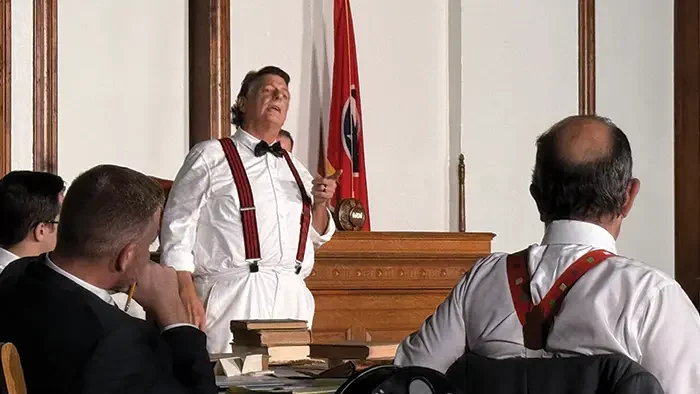
Austin Peay profoundly misjudged the moment when he, with the swoop of a pen and the authority vested in him as Tennessee’s governor, signed the Butler Act into law on March 21, 1925.
His motivation to court favor with rural legislators and their electorate was shortsighted. None of the hundreds of bills Peay signed into law during his four years as governor were more significant than House Bill 185. It was the first law in the United States to criminalize teaching human evolution in public schools. The governor dismissed the law as almost frivolous, stating, “Probably the law will never be applied,” and “Nobody believes it is going to be an active statute.”
RELATED: Check out more stories on the Texas flooding and response.
For more stories at your doorstep, subscribe to The Baptist Paper.
He was wrong. His action triggered the “Trial of the Century,” as teacher John T. Scopes was arrested, charged, tried and found guilty of violating the Butler Act just four months later.
On its surface, State of Tennessee v. John Thomas Scopes may have looked like a case to settle teaching human evolution, but it was more than that.
As Dayton’s historic courthouse fills this week for the trial’s 100th anniversary re-enactment, the significance of Scopes echoes in courtrooms across America today. At stake then, as now, were significant issues like parental rights, academic freedom, individual rights, majoritarian rule, science versus religion, fundamentalism versus modernism, and the role of government in education and people’s lives.
The publicity plan
Dayton was struggling. From a peak of over 3,000 residents in the early 1900s, the town had dwindled to just over 1,000 by 1925, desperately needing an infusion of industry, people and money.
A spark came in the May 4, 1925, issue of the Chattanooga Times, when the American Civil Liberties Union (ACLU) advertised support for any Tennessee teacher willing to challenge the Butler Act in court.
George W. Rappleyea, a New Yorker managing local coal and iron mines, saw the ad and, with Fred Robinson and other business owners meeting at Robinson’s drugstore, recruited teacher John T. Scopes. They contacted the ACLU and devised a plan that, for 12 days, drew the world’s attention to Dayton.
The ACLU aimed to challenge the law’s constitutionality, but Rappleyea and his group saw economic opportunity. They even created a promotional booklet highlighting Dayton as an ideal place to live and work.
The times and the tensions
Cultural tensions ran high in the 1920s. The “Jazz Age” ushered in liberalism among younger generations, with battles over Prohibition, urbanization’s divide with rural communities, European immigration and more.
Traditionalists feared the erosion of religious and moral values, while modernists embraced innovation, freedom and diversity.
The Butler Act, the ACLU, and Dayton’s business community crystallized these tensions in a small Tennessee town. For many, including John D. Freeman, editor of the Baptist and Reflector, the trial was about more than the law’s legality.
Freeman, who was present for the trial, wrote in the July 9, 1925 edition of the Baptist and Reflector: “The issue of evolution and Tennessee’s law will not be settled by the trial at Dayton. When free-thinkers come into our state to override our constitutional rights as a free people and to set free one who has knowingly broken a state law, what are we going to do? The struggle is (happening) in earnest and the only thing that will be pleasing in the sight of God is for his people to wage the battle with all the power they possess. If we compromise with the Amalekites, our doom is sealed.”
The personalities
William Jennings Bryan and Clarence Darrow embodied society’s divides. Bryan, the “Great Commoner,” was a charismatic orator, lawyer, and three-time Democratic presidential nominee who championed fundamentalist Christianity and opposed evolution. He joined the prosecution and arrived in Dayton to great fanfare.
Darrow, the “Great Defender,” was a renowned defense attorney and civil libertarian. A committed agnostic, he argued belief should rest on reason and evidence, not faith. He arrived in Dayton as a celebrity to defend Scopes.
“Bryan defended the law, asserting Tennesseans’ right to ensure their children return from schools with unchanged values,” said Rick Dye, president of the Rhea Heritage Preservation Foundation, who portrays Darrow in the trial’s 100th anniversary re-enactment.
“Darrow charged that the Butler Act regressed to 16th-century stake burnings of men who dared to bring any culture, enlightenment and intelligence to the human mind.”
The outcome
The trial hinged on whether Scopes violated the Butler Act. The defense conceded his guilt to focus on the law’s constitutionality and the broader debate of academic freedom versus religious fundamentalism. Judge John T. Raulston excluded expert scientific testimony, limiting Darrow’s strategy. In a bold move, Darrow called Bryan to testify, aiming to expose contradictions in biblical literalism.
Bryan, the prosecutor, became the defendant of religion itself. Conservatives believed Bryan’s stance protected against social Darwinism, eugenics, or worse, viewing it as a moral safeguard, not anti-science. However, journalists like H.L. Mencken portrayed Bryan as anti-intellectual, framing Darrow’s performance as reason triumphing over superstition. The trial became a symbol of modernism versus fundamentalism, with Bryan’s side seen as the loser.
The epilogue
No record exists of Scopes paying the $100 fine. The Tennessee Supreme Court overturned his conviction in 1927 on a technicality. The Butler Act remained law until its repeal in 1967. In 2022, Tennessee Gov. Bill Lee signed the Academic Freedom Act, which, while distinct in tone and scope, echoes the Butler Act’s aim to regulate classroom content.
Darrow continued lecturing, writing, and debating religion and justice until his death in 1938, revered as a champion of free thought.
Bryan died of a stroke five days after the trial while still in Dayton, reportedly heartbroken by his confrontation with Darrow. Editor Freeman wrote in the July 30, 1925, Baptist and Reflector, “Long after those who have so villainously slandered him during the Dayton trial have sunk into social, political and spiritual oblivion, William Jennings Bryan will be known and loved and honored upon the pages of American history.
“And upon the records of eternity no name will be more resplendent than that of him who like the Apostle Paul was willing to be accursed for his own people’s sake.”
EDITOR’S NOTE — This story was written by Chris Turner and originally published by the Baptist and Reflector.