While still lauded by many for his streamlined, no-nonsense approach to leadership, Jeff Iorg’s recent assessment of how to move the SBC forward has garnered pushback from some church leaders.
Iorg, president and CEO of the SBC Executive Committee, is asking Baptists to return to the traditional style of Cooperative Program giving without designating around certain entities — and to consider increasing gifts at the same time.
Disagreement over giving approach
Descriptions like “arrogant” and “out of touch” surfaced from a few voices online (not part of the EC board) regarding his plea because the negative designation approach is used by some churches to express concern or disappointment in the work of an entity. Iorg seems unfazed by the criticism.
He is known for an efficient leadership style that allows all voices to be heard, facts presented, votes taken and then for those involved to move on with what the body decides. No drama, no extra comments, just matter of fact — a “this is where we are and what has been decided” mindset.
Approving recommendations
And the flow of the Sept. 22–23 EC board of trustees meeting in Nashville followed suit. The various subcommittee meetings held privately via video conferencing prior to the public in-person meetings kept agenda items flowing smoothly.
Most questions had already been answered by the time the group gathered, so the 17 recommendations coming from the four subcommittees were all approved with little to no public discussion. Also, many of the items were fairly routine, which allowed board members to move them along quickly.
Discussion over motion to sue Hunt
Of the four recommendations coming from the EC officers, only one garnered discussion — the recommendation to decline filing a lawsuit against former SBC President Johnny Hunt. While EC members voted overwhelmingly not to sue Hunt, two “nay” votes were voiced and recorded.
EC member and former board chair David Sons of South Carolina suggested delaying the recommendation to February to see if the Hunt case might be resolved by then.
EC member Dani Bryson (a Tennessee attorney) described “a moral cost-benefit in standing up for what is right.”
“I think we, in our fiduciary capacity, need to look at standing up for the Executive Committee and for the SBC to discourage those future suits, if there is no merit,” she said.
Benjamin Cole, a member of and messenger from North Lexington Baptist Church in Lexington, North Carolina, made the motion about suing Hunt in June during the SBC Annual Meeting in Dallas. Referred to the EC for consideration, the motion says the reasoning for a counter lawsuit was “to recover legal fees … against [Hunt’s] multi-million-dollar frivolous claim that has cost us and our churches countless resources.”
In a Sept. 22 letter sent to EC board chair Tony Dockery of California, Cole asked Dockery to consider postponing a recommendation to see what might happen with Hunt’s case since all but one count has been dismissed so far.
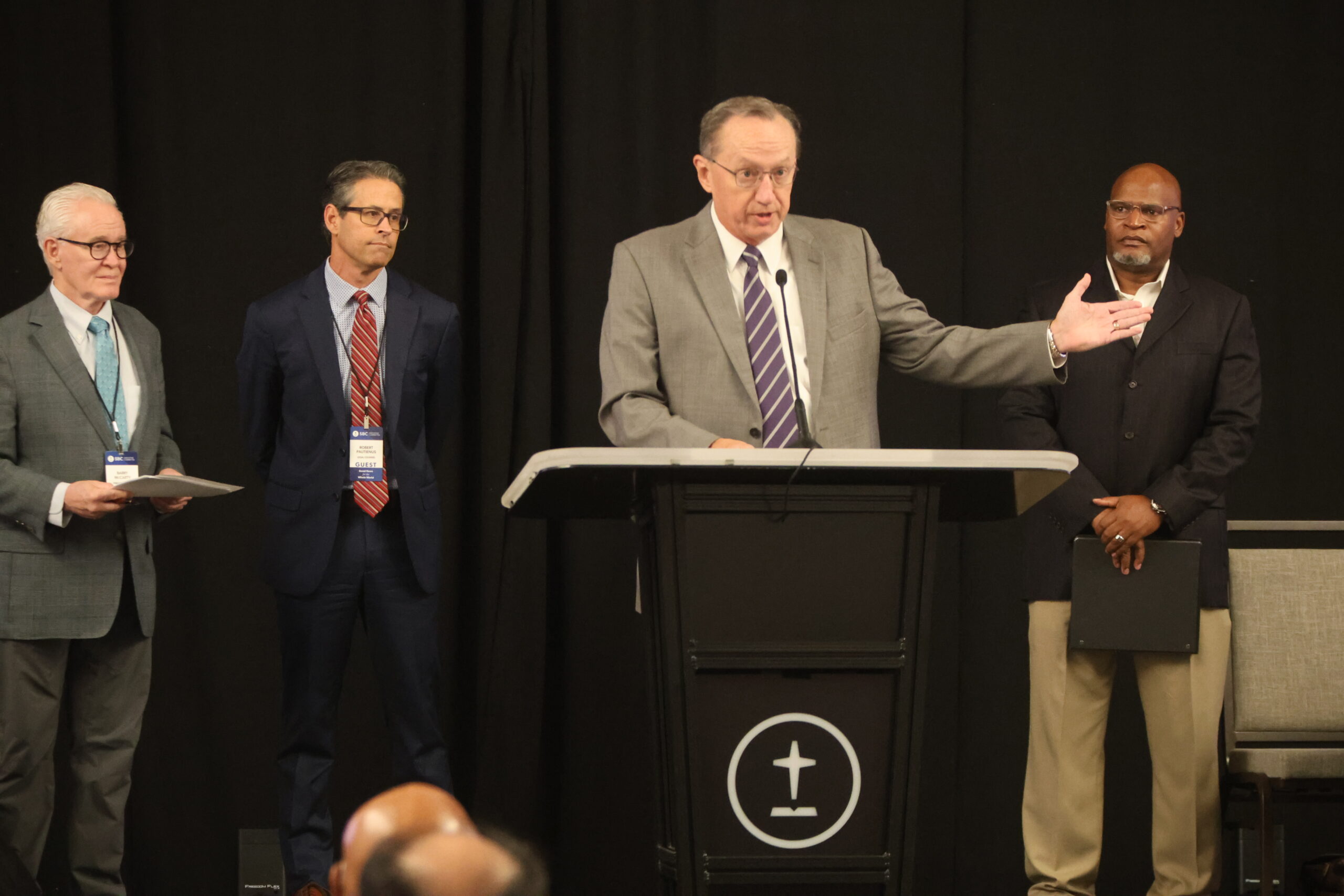
Robert Pautienus of Fidelis Law PLLC, who serves as general counsel for the EC in a contract role, explained that the idea of a countersuit isn’t possible. If the EC wanted to file a lawsuit against Hunt, then it would have to wait until all matters of Hunt’s suit were finalized and the type of suit needed would be difficult to prove and maintain, thus adding more legal fees.
Pautienus and Iorg urged EC board members to decline to sue Hunt.
In executive session
In other news, EC members met in executive session for a little more than 90 minutes to hear legal updates, discuss personnel matters, receive a report from the Credentials Committee and to undergo a trustee refresher training.
The first three are routine for the EC’s executive sessions, but the trustee training is a new item. Iorg referenced it in his Monday evening (Sept. 22) report as a new part of the EC’s fall meeting each year.
“We will do this tomorrow (Tuesday, Sept. 23) during executive session with an emphasis on board function and a discussion about ways we can improve our internal operations as a committee to be able to more effectively serve Southern Baptists and more efficiently do our work as a group,” he said Sept. 22. “As part of that we will be discussing our meeting format and hearing your input on ways we can both streamline and improve committee operations.”
As far as why the training needed to be done in executive session, Iorg said Sept. 23, “We also discussed distribution and management of information and staff performance in supporting the EC processes which necessitated the executive session.
“The trustee refresher training is just good board practice to periodically train and retrain on how a board functions,” he added. “Every effective board does it. … It may or may not be in executive session in the future depending on the issues. Since this training is about ‘how the board can function better,’ it does not involve votes. They are more like a class setting with discussion and suggestions. Sometimes, we might even bring in an outside consultant to train on a specific issue. … We’ll see how it develops as we implement this process over the next few years.”
Credentials Committee on Houston church
Regarding the Credentials Committee report, EC members approved the recommendation to “formally recognize the discontinued relationship of Fountain of Praise, Houston, Texas, with the Southern Baptist Convention as demonstrated by the church’s lack of reported financial participation for at least the last 10 years and its lack of intent to cooperate to resolve a question of faith and practice.”
No other information about Fountain of Praise was reported by EC members, but Baptist Press noted the church’s website lists Mia K. Wright, wife of pastor Remus E. Wright, as a co-pastor of the church.
Whether the concern sent to the Credentials Committee about Fountain of Praise initially stemmed from the co-pastor designation or the lack of financial participation is unclear.
Financial updates
And speaking of finances, EC members reviewed financial reports through the third quarter of the fiscal year, which ends Sept. 30.
The 2024–2025 EC operating budget report through the third quarter was acknowledged (and approved as having been received as information), but no numbers were shared publicly. The Baptist Paper has asked EC staff for that information, which has traditionally been provided.
The 2024–2025 SBC CP allocation budget receipts through the third quarter were reported publicly — $141,224,322, which is a 2.92% decrease from the same period last year.
The total CP allocation budget approved for 2024–2025 was $190,250,000. A report from the EC with the final numbers for the year should be released in the next few weeks.
The new CP allocation budget year (2025–2026) begins Oct. 1 with a $190 million budget.