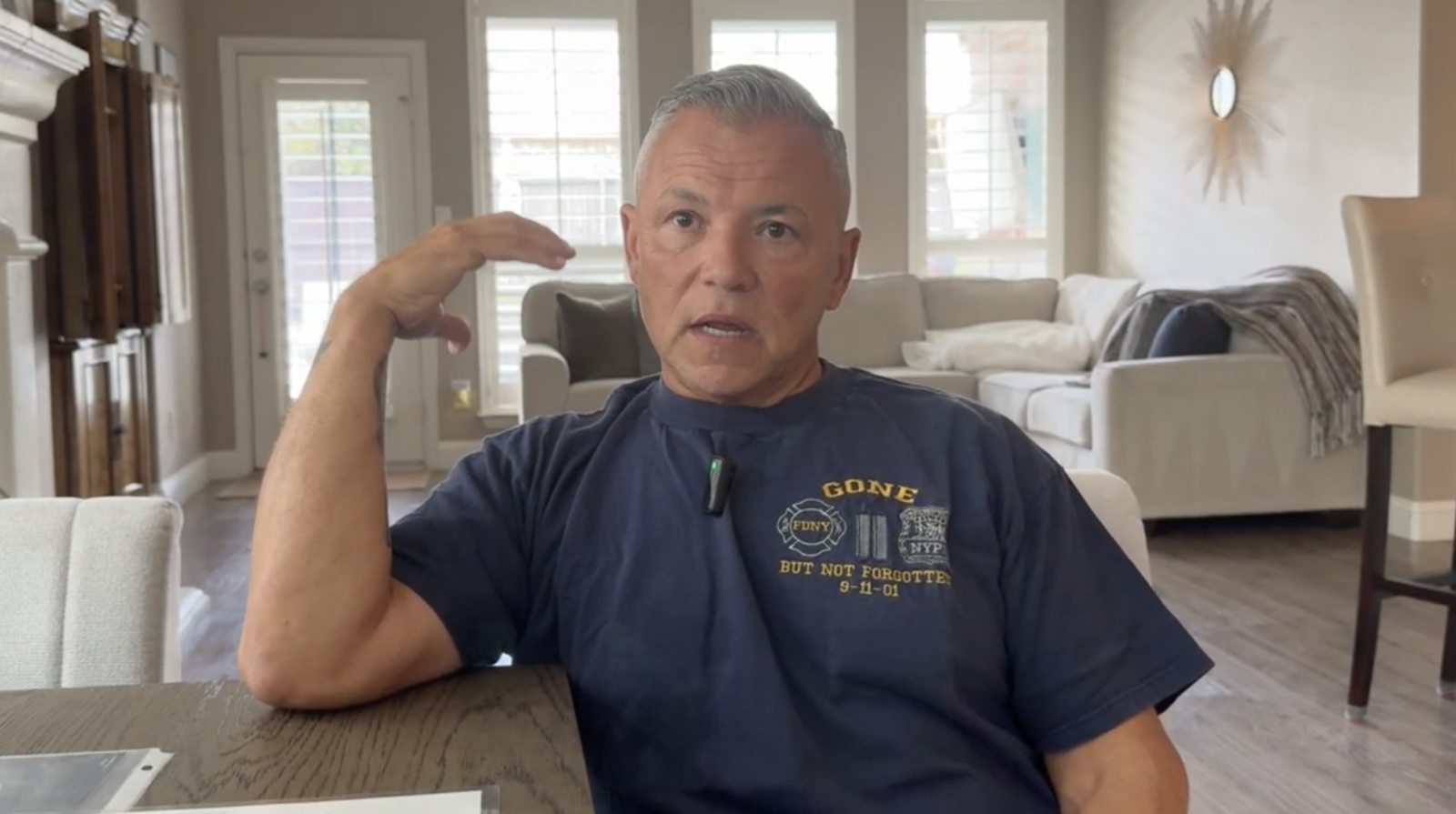
Survivors of 9/11 almost always mention what a beautiful, clear day it was on Sept. 11, 2001. Gus Cabarcas, a former New York police sergeant, lives in Texas now. He was one of the first responders at the World Trade Center. He mentioned the calm, clear skies of that morning.
Follow the full coverage of the 25th anniversary of 9/11 with Ground Level Reports
Just coming off an overnight shift Sept. 10 in Brooklyn North, Cabarcas was commuting an hour home to Long Island, New York. His wife called when he was about 10 minutes from home asking if he’d heard what happened at the World Trade Center.
“[I] got home, grabbed some clothes, and I turned around, went back to work,” Cabarcas said.
Everyone working
All the first responders were heading back into the city.
“I didn’t get a chance to sleep or anything,” he said, arriving in the city just as the second tower came down. “Everything was covered in a white.”
The police sergeant, along with other officers and first responders, spent hours looking for survivors and trying to avoid the burning pile that was the World Trade Center.
There were a lot of unknowns in the first hours, days and weeks.
“Everything was on fire,” he said. “It looked like a nuclear bomb.”
All night, the city was eerily quiet with the only sound being military jets flying overhead. Many of those first days, responders filled bucket after bucket with debris, mainly looking for survivors and remains.
His first day home was Sept. 14, but he only went home for six hours — sleeping two before heading back to the pile.
For the next six months, “If you weren’t working at the pile, you were working at the landfill island” (where all the debris from Ground Zero was stored) or attending funerals.
Toxic results
While the number of police officers killed in the line of duty is recorded at 23, Cabarcas said the number has surpassed 500 because of the toxins responders and survivors were exposed to at the time.
The next months, Cabarcas was assigned at the landfill at the conveyor belts, looking for remains and other items. He found a driver’s license in a purse.
“My goal now is to continue living for the ones that are no longer here,” he said. “I live my life like today’s my last day. Tomorrow’s not guaranteed.”
“So even though it happened 25 years ago, we’re still seeing the results from that tragic day,” he said.
Forgotten history
Cabarcas expressed sadness at people forgetting or not being taught what happened. He referred to the famous Winston Churchill quote: “Those that fail to learn from history are doomed to repeat it.”
Cabarcas has not visited the memorial but is haunted by the smell that lingered after the attacks.
“That, to me, is a huge cemetery,” he said.
Health issues
A part of the World Trade Center Health Program, Cabarcas has two nodules in his lungs that are being watched by medical professionals.
Every year, Cabarcas tries to stay busy Sept. 11 but still takes time to remember those who survived in prayer as well as praying for the victims’ families.
He estimates the NYPD is losing two people a day because of diseases related to the toxins released at the site.
Originally from South America, Cabarcas loves his country: “This is the best country in the world. You could be whatever you want to be in this country.” He and his wife didn’t have children in 2001 but have since raised two children.
He wants people to understand there’s good and bad people.
“I don’t think we learned from that attack.”