“If you took all the people on our planet with disabilities and added them together, you would have the third largest country in the world, just behind India and China,” asserted Tom Stolle, executive director of the Baptist Convention of Maryland/Delaware.
“It is quite possible that individuals affected by disabilities are the largest lost people group on the planet,” he added. “We cannot leave them behind.”
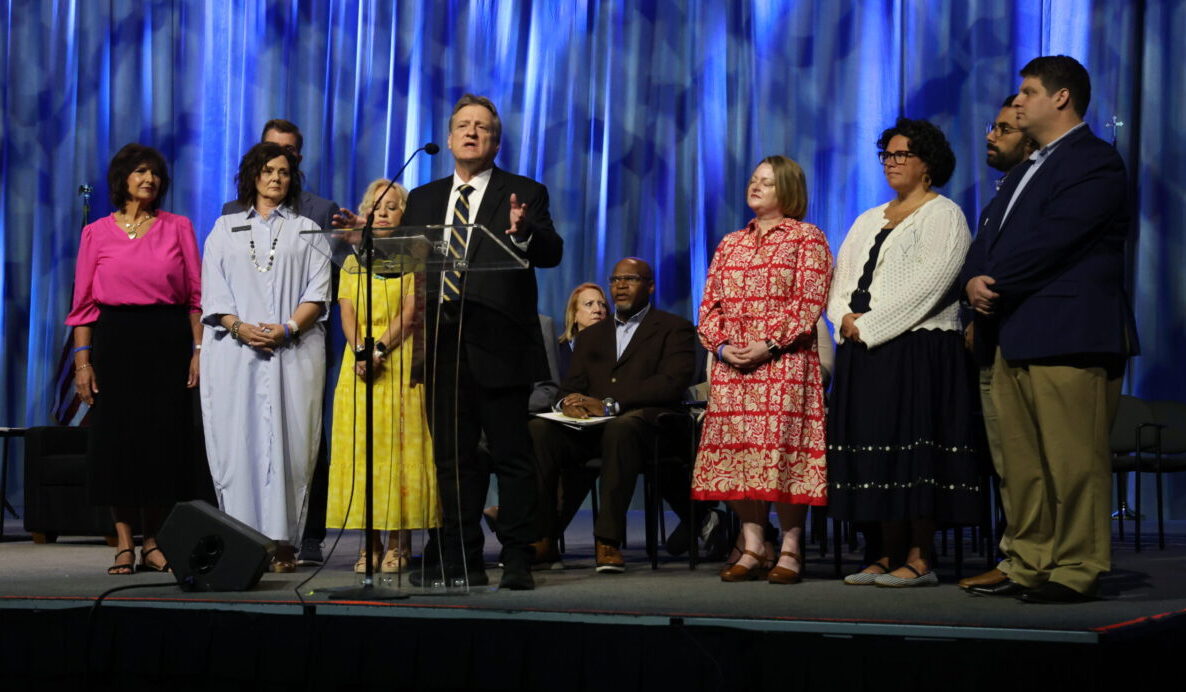
On Wednesday, June 10, the Southern Baptist Convention’s Disability Ministry Task Force presented its report and recommendations to messengers at the annual meeting of the 2026 SBC Annual Meeting in Orlando.
In response to a 2025 motion by Benjamin Hankin, a messenger from New Jersey, the SBC Executive Committee voted at its September meeting to form this task force to study the availability of special needs ministry resources for churches.
Tom Stolle, the father of an adult son with special needs, chaired the task force.
In his report, Stolle highlighted a 2020 study by Lifeway Research, which reported that 99 percent of evangelical pastors believe individuals with disabilities would feel welcome in their churches.
However, “many people with disabilities and their families have expressed surprise and skepticism at this finding, citing the persistent physical, social and relational barriers they encounter when visiting congregations,” Stolle said.
“This disparity suggests that barriers to inclusion remain significant, as evidenced by estimates that only 15-20 percent of evangelical churches in the United States have any form of disability ministry,” said Stolle, sharing some of the common barriers parents and caregivers of individuals affected by developmental and intellectual disabilities face when considering if they should take the “risk” of attending church.
To name a few, Stolle said parents have seen their children repeatedly experience rejection and marginalization. They may fear their child will have a meltdown. Parents may be very disconnected socially. And parents may assume the church does not understand their situation and may fear the worst.
“Personally, my family, including my son, have experienced all these stated barriers,” said Stolle. “So many other families have experienced the same barriers.”
Moreover, recent census data indicates that approximately 2 in 7 U.S. families include a member with a disability, yet this proportion is not reflected in church participation, he stressed.
During a press conference, when discussing raising his son Jimmy into adulthood, Stolle said the hardest part wasn’t the violence. It wasn’t the destruction in the home. It wasn’t the “over and over grinding through the same routines.”
It was “the fact that we felt like no one saw us,” he said.
Stolle pointed to Matthew 20, where two blind men cry out to Jesus.
“The crowd tells the men to shut up,” Stolle said. “But Jesus hears them. Sees them. Stops for them. Heals them. The men, formerly blind, now follow him.”
He posited, “What would it look like if SBC churches, state conventions, and national entities took steps that essentially states, ‘We see you. We hear you. We love you. Jesus loves you. There is a place for you at our church.”
That’s a game changer! he said, extending the question to evangelism strategies.
“Any comprehensive evangelism strategy that does not include individuals and families affected by disability is not a comprehensive strategy. It is a partial strategy.”
The task force discussed the availability and accessibility of resources for disability ministries across Southern Baptist churches, how churches are presently engaging in ministry to individuals and their families affected by disabilities, and how they can better come alongside and support families who have loved ones that are affected by disability.
They have made requests the across the landscape of the SBC, and not just state conventions and local churches, but also requests for SBC entities – North American Mission Board, International Mission Board, six seminaries, GuideStone Financial Resources, the Ethics & Religious Liberty Commission and WMU – to help the initiative.
“We believe collectively, our work is to advance the Kingdom deeper into the arena of disability and this will result in many coming to Jesus,” Stolle said.
Some of the overarching goals for Southern Baptist and church leaders include:
- Understand that 15-20 percent of the population has a disability, but they are underrepresented in our churches, making this an opportunity to reach families with the hope of the gospel.
- Identify key church leaders and families in the congregation impacted by disability to help address potential physical and social barriers that may be preventing special-needs families from attending church.
- With help from Southern Baptist entities and/or parachurch organizations, develop a plan for inclusion for children, teens and adults with disabilities that includes evangelism, discipleship, fellowship and service opportunities.
- Build trust within one’s communities to reach families affected by disability by meeting practical needs and pointing them to Jesus, who meets their deepest need.
Some of the recommendations for SBC entities include adding disability ministry specialists and consultants to teams; adding accessibility options and modifications to existing curriculum and writing new curriculum; increasing and promoting resources and trainings in state conventions, mission boards and policy arenas; developing evangelism tools and strategies; and offering seminary certificate programs, classes and degrees in disability ministry,
At a press conference, SBC Executive Committee President Jeff Iorg said, “This was one of my best days in leadership in the SBC because of what happened with this task force, how it was adopted, and the overwhelming enthusiasm Southern Baptists have demonstrated toward this report.”
“This is the best day that I’ve had is a Southern Baptist in my entire life,” Stolle stressed. “And as a parent of an adult child with severe disabilities, I feel seen by Southern Baptists, and I pray that so many others feel seen by Southern Baptists.”
The task force members included Stolle (chair, Delaware), Marci Campbell (Oregon), Shannon Deihl (Maryland), Amy Meekins (Virginia), Gus Pacheco (North Carolina), Sandra Peoples (Texas), Christa Smith (Florida), Cody Watson (Florida), and entity representatives Jana Magruder (Lifeway), Ray Clark (NAMB), John Brady (IMB), and RaShan Frost (ERLC).
EDITOR’S NOTE — This story was written by Shannon Baker and originally published by Baptist Press.