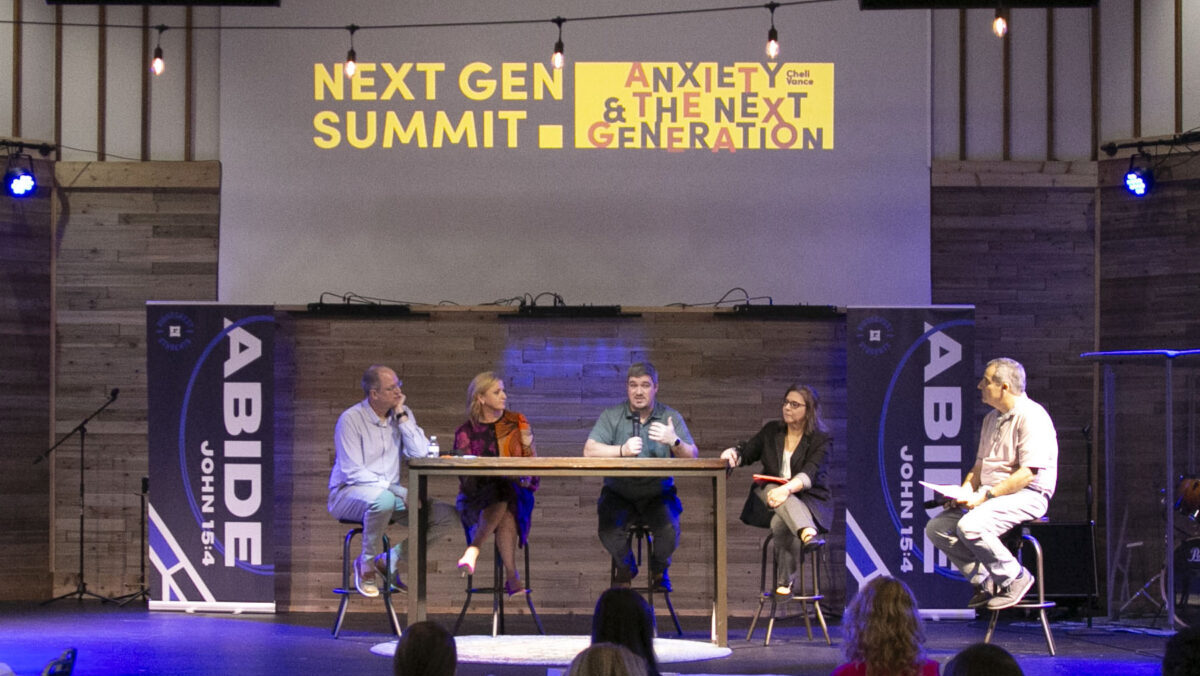
During the Next Gen Summit, presented by the Mississippi Baptist Convention Board, guest speaker Cheli Vance tackled the issue of “Anxiety in the Next Generation.” The event was recently hosted at Ridgecrest Baptist Church, Madison.
Vance, who co-leads a young adult Sunday school class at First Baptist Church Jackson, was recruited through the MBCB Discipleship/Sunday School department from 2008 to 2023 to lead student staff teams for summer camps on Mississippi College’s campus. Year after year, she noticed how each new group showed up less capable and ready than the last.
For more stories at your doorstep, subscribe to The Baptist Paper.
SIGN UP for our weekly Highlights emails.
In 2008, students required little supervision and solved problems on their own. In 2012, Vance realized their interactions and abilities to follow directions had dwindled significantly. By 2023, students were distracted, lacking self-discipline, and unable to compose themselves after a mistake.
Over the years, Vance had become frustrated with the behaviors her generation often regards as lazy, inept, or rude, until she began to research the younger generations. Soon the real issue was clear: the vast majority of Gen Z and Gen Alpha exist in a crisis of anxiety.
What happened, and why are older generations struggling to relate to the younger?
Closer look
Between generations, the internet, smartphones and social media were introduced. But is it fair to fully blame screens?
“We view the world through the lens of our childhood without the internet,” Vance explained during the Feb. 19 event, “yet we have generations which have never, ever known life without it. Then we have millennials who are stuck in the middle, trying to explain both viewpoints to either side.”
It may appear as though the solution is to fault the phones and advise young people to stay offline, but Vance cautioned attendees from jumping to this criticism. “Gen Z and Gen Alpha are very aware of the harmful effects of technology. They can also tell you all the benefits of it. Younger generations are also aware of how often their parents and grandparents pick up the phone themselves.
“We didn’t get into this situation with technology overnight, and we’re not going to overcome it overnight,” Vance noted. “We can’t change the generation people are born into, but we can change how we talk about people in other generations. We can study the generational differences to understand, not to criticize. We also can’t change the importance and necessity of technology in our everyday lives, but what we can change is how and when we personally use technology and how we talk about technology with different generations.”
An ‘everybody problem’
With a table activity, Vance demonstrated that “tech interference” or “phone-snubbing,” the act of focusing on one’s phone instead of paying full attention to the people around you, is not just a Gen Z and Gen Alpha problem – It is an everybody problem.
Somewhere along the way, our interpersonal connections have weakened. “This isn’t just about Gen Z and Gen Alpha,” Vance affirmed. “It’s about all of us, because God has called us to be a Body of believers together.”
Vance said connecting with Gen Z and Gen Alpha involves reframing, relating, rebuilding trust, and retrofitting.
Full story.
EDITOR’S NOTE — This is an except of a story written by Lindsey Williams and published by The Baptist Record.